Nozzle wear, pressure loss, and the hidden cost of an oversized orifice
Establish a new-nozzle baseline, measure flow and operating pressure, distinguish wear from blockage and upstream faults, and replace the nozzle by the pump and manufacturer chart.
A worn nozzle can look perfectly clean
A pressure-washer nozzle wears from water, suspended particles, chemistry, heat, and handling. The orifice gradually becomes larger or loses its intended shape. The change may be too small to see without measurement, yet large enough to lower operating pressure, distort the pattern, increase flow, and slow the work.
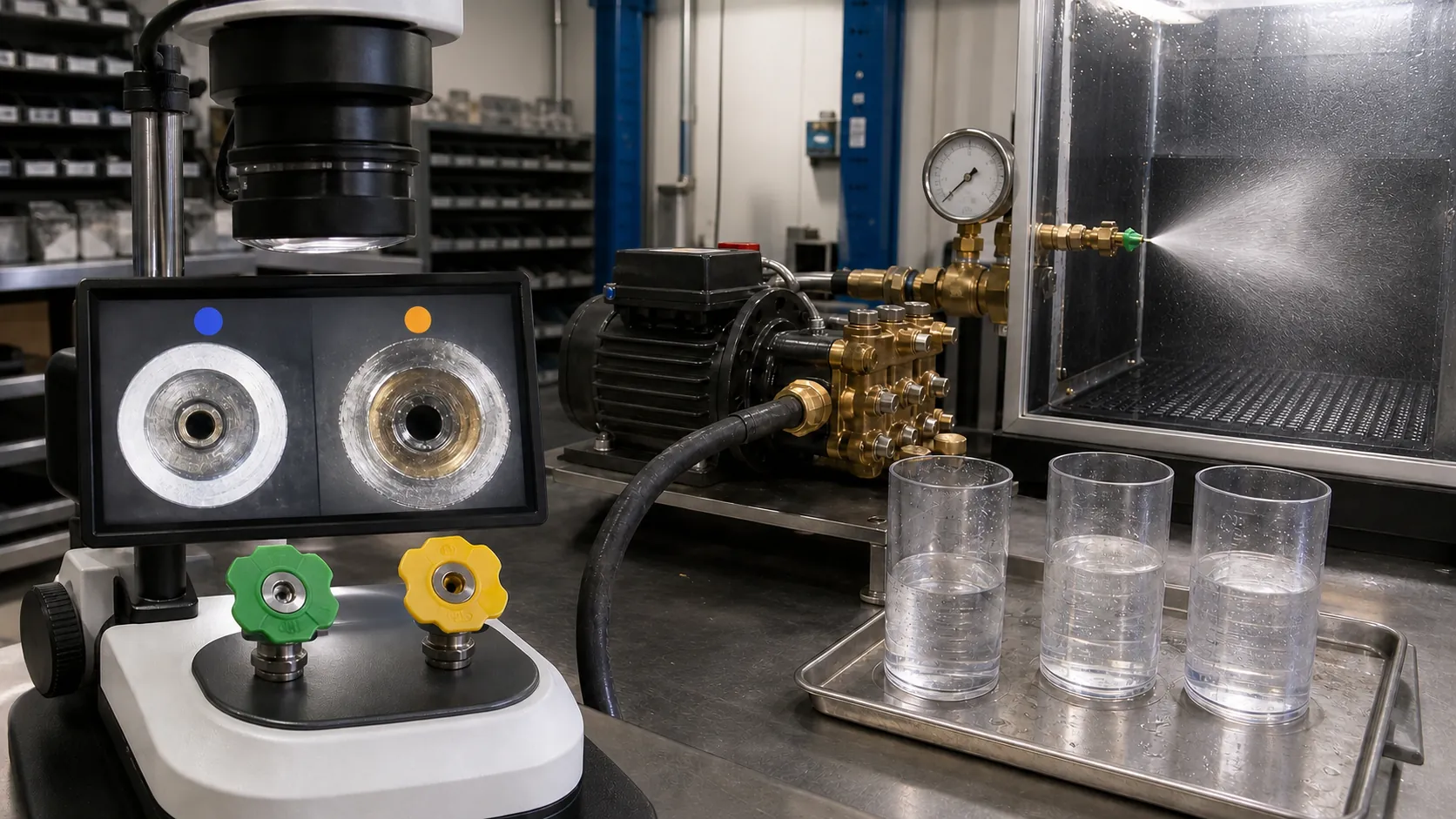
On a positive-displacement pump, an oversized or worn orifice can pass more liquid at a given pressure than the intended size. The system settles at a lower operating pressure if the pump cannot supply that added flow at the former pressure. The result may feel like a weak pump even when the pump is doing exactly what the opening allows.
Know which number belongs to which part
The pump has a rated flow and pressure curve at specified operating conditions. The nozzle has an orifice size and spray angle selected to work with that output. The machine also contains an unloader, hose, gun, injector, fittings, and gauge, each of which can affect what is measured.
Use the pump and equipment manufacturer's nozzle chart for the exact machine. Do not select by tip color alone; color commonly identifies spray angle within a product family, not the hydraulic size required by every system. Confirm orifice designation, angle, material, pressure rating, temperature, connection, and chemical compatibility.
The unloader is a safety and control component, not a routine substitute for the correct nozzle. Tightening it to chase pressure with an oversized orifice can overload the pump, engine, hose, gun, or fittings and may defeat the manufacturer's setup.
Build a baseline while the system is healthy
Install a verified new nozzle of the specified size. With clean water, adequate inlet supply, a serviced filter, known hose and gun, and a suitable calibrated gauge in the manufacturer-approved location, record:
- operating pressure with the trigger open;
- delivered flow measured by an appropriate timed-volume or calibrated method;
- spray pattern, angle, alignment, and distribution;
- cleaning result at a fixed safe distance on a repeatable test surface;
- engine speed or electrical operating condition where the manual calls for it;
- water temperature, chemical use condition, and total service time.
Keep the old and new nozzles clearly separated. A baseline is valuable only when the rest of the system and test method remain comparable.
Wear, blockage, and damage do not look the same
| Condition | Likely performance | What to do |
|---|---|---|
| Uniformly enlarged orifice | Higher flow tendency, lower operating pressure, reduced impact | Compare flow and pressure with the correct new nozzle |
| Eroded or asymmetric opening | Heavy edge, streaks, poor distribution, shifted aim | Replace; do not reshape in the field |
| Partial obstruction | Reduced flow, pressure rise or pulsing, distorted pattern | Shut down and clean only by the manufacturer's specified method |
| Wrong nozzle size | Oversize may lower pressure; undersize may raise system load or force bypass | Return to the charted size and verify unloader setup |
| Cracked body or damaged seat | Leakage, poor retention, erratic jet | Remove from service immediately |
| Correct nozzle with low pressure | Fault may be inlet supply, pump, valves, seals, unloader, injector, hose, gun, or gauge | Diagnose the complete system rather than drilling or downsizing the tip |
Never look into a nozzle or point it toward a hand. Depressurize and isolate the machine before removal. A probe that is too hard or large can scratch the metering surface and turn a blockage into permanent oversize wear. Use only the cleaning tool and direction named by the nozzle manufacturer.
Measure capacity change
Industrial spray guidance notes that nozzle wear often appears as increased capacity before it is obvious visually. A practical maintenance program trends flow at comparable pressure, or pressure at comparable pump condition, against the new-nozzle baseline. It also inspects the pattern.
Calculate percentage flow increase as measured worn-nozzle flow minus baseline flow, divided by baseline flow, multiplied by 100. Set the replacement criterion from the equipment, nozzle, process, and quality requirements rather than copying a universal percentage from another application.
Measurement tools need their own checks. A damaged gauge, inaccurate tachometer, unverified container volume, trapped air, changing inlet supply, or different hose can create a false nozzle diagnosis. Repeat an unexpected result before adjusting equipment.
The hidden costs spread beyond pressure
- More water: a worn opening can increase consumption and refill frequency.
- More chemistry: downstream mixture behavior may change when water flow changes, altering concentration and total product use.
- More labor: reduced impact or uneven coverage leads to slower passes and rework.
- More runoff: excess volume raises containment, recovery, and disposal demand.
- Poor uniformity: a distorted fan can stripe a surface or leave untreated bands.
- Bad troubleshooting: unnecessary pump or unloader adjustment can create additional faults while the inexpensive worn part remains installed.
Cleaning more closely to recover impact is not a neutral workaround. Short distance narrows coverage and can damage paint, wood, mortar, seals, glass edges, and other sensitive materials.
Diagnose in a fixed order
- Confirm adequate clean inlet water and remove air by the manual.
- Verify pump speed or power condition and inspect for leaks.
- Check filter, injector position, hose, gun, fittings, and unloader behavior.
- Install the correct known-new nozzle without changing other settings.
- Measure pressure, flow, and pattern against baseline.
- If performance returns, retire the worn nozzle and record its service life.
- If it does not, continue qualified system diagnosis rather than fitting a smaller tip.
Store nozzles clean, protected, and identified. Do not throw them loose with drill bits, wire, fittings, and abrasive debris. Track service hours or water volume where practical, but let measured performance and condition control replacement.
A consistent power-washing process depends on the full hydraulic system. The nozzle is small, but it defines the opening through which the pump's work reaches the surface. Treat it as a measured component, not a colored accessory.