
Glass chips and edge damage: why polishing is not a structural repair
Locate the defect relative to edges, holes, supports, and safety functions, document propagation and loading, and refer weakened glazing rather than polishing away visible evidence or altering heat-treated glass.
A smooth edge is not proof of a strong edge
Polishing can make a sharp chip feel rounded and can reduce the visibility of a shallow surface blemish. It does not reconstruct the glass that was lost, restore the original edge quality, reverse a crack, or certify the pane for its design load. Removing more material may erase evidence while enlarging the affected geometry.
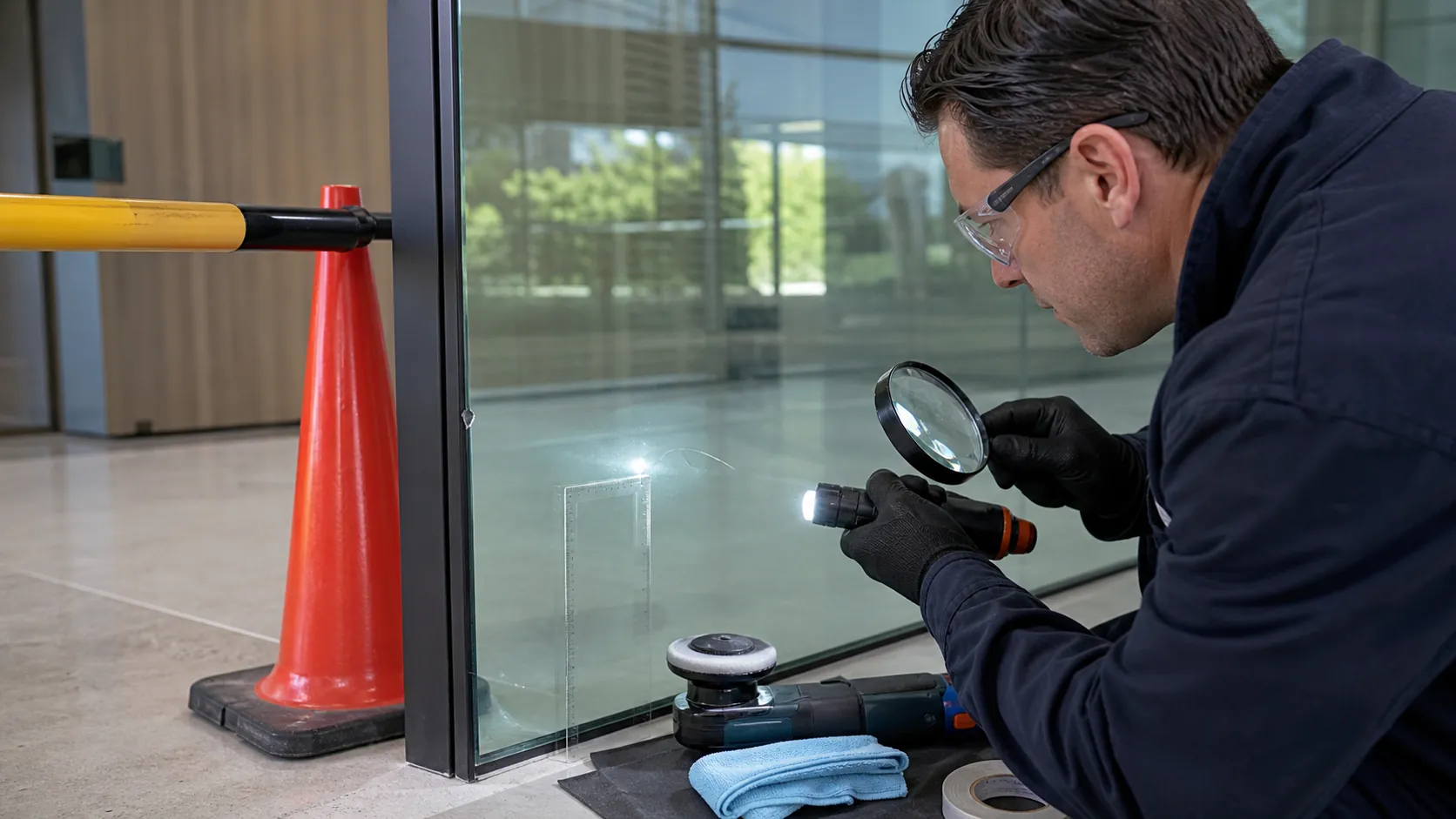
Vitro identifies edge quality as a critical factor in glass strength and notes that damage can substantially reduce resistance to thermal and mechanical loads. A pane may remain intact until wind, temperature, impact, frame movement, or another load combines with the weakened location.
Locate the defect before naming it
| Location | Examples | Primary concern |
|---|---|---|
| Exposed face away from edges | Small pit, shell, scratch, shallow impact mark | Depth, stress concentration, optics, coating, and whether a crack begins |
| Supported or concealed edge | Chip, shell, vent, crush, glass-to-metal contact | Reduced edge strength, hidden propagation, frame load, thermal stress |
| Free exposed edge | Chip on a guard, door, partition, shelf, or butt joint | Strength, human contact, sharpness, code and structural role |
| Corner | Missing corner, diagonal crack, impact shell | Intersecting edges and support geometry |
| Hole or notch | Chip at hardware cutout, hinge, fitting, or fastener | Concentrated load and limited clearance |
| Laminated or insulating edge | Chip with delamination, seal damage, moisture, or spacer concern | Glass strength plus assembly durability and retention |
Use neutral terms until a qualified person classifies it. Calling every missing fragment a cosmetic chip can hide a crack; calling every surface pit structural can prompt unnecessary replacement.
Identify glass and safety function
Record glass type, thickness, heat treatment, laminate, coating, frit, holes, notches, edge finish, support, fasteners, and installation. Locate safety marks but verify them against records. Determine whether the lite is a door, guard, railing infill, shower enclosure, overhead panel, storefront, interior partition, fire-rated assembly, impact system, or ordinary window.
Safety glazing is evaluated as a product and installation, not by whether a technician can round a chip. A visible mark does not authorize field modification, and an absent mark does not prove annealed glass.
Document without stressing the pane
- Barricade the area when falling glass, sharp contact, or loss of guarding is credible.
- Photograph the full lite, supports, hardware, and surrounding loads before close work.
- Use raking light and magnification without pressing on the glass.
- Map defect position from fixed references. Record approximate width, length, depth indication, and distance to edge or hole with noncontact methods where possible.
- Look for a line leaving the chip, branching, change since earlier photos, moisture, edge whitening, or movement.
- Record temperature, shade, wind, door operation, impact history, frame contact, and vibration.
- Refer concealed-edge inspection or removal of glazing stops to a qualified glazier.
Do not tap the pane, flex the edge, insert a metal probe, or trace a suspected crack with pressure. The desire to measure must not create the next fracture.
Heat-treated glass cannot be refabricated in place
Annealed glass is cut and edged before many downstream processes. Heat-strengthened and tempered glass receive their permanent stress profile after fabrication. Guardian states that heat-strengthened glass cannot be cut or drilled after heat treatment and that alterations such as edge grinding can cause premature failure.
Field grinding a tempered edge, enlarging a hole, cutting away a corner, or drilling a crack stop is not a repair method. It changes geometry and disturbs a stress field without returning the lite to the furnace or safety-glazing certification process.
Where surface restoration has a limited role
A shallow scratch or surface blemish away from critical edges may be a candidate for a controlled glass-restoration test. The test still needs defect-depth assessment, glass identification, coating check, heat control, optical acceptance, and containment.
The scope must exclude structural claims. Polishing can reduce a face defect by removing surrounding surface material. It does not increase edge strength, arrest an active crack, restore a safety mark, repair a laminate, reseal an insulating unit, or prove capacity.
Do not blend from a face scratch into an edge chip. The transition removes glass near the location where edge quality matters most and can obscure the original condition.
Conditions that require glazing review
- any crack, growing line, or change between inspections;
- damage at a supported edge, corner, hole, notch, fastener, or hardware fitting;
- door, guard, overhead, sloped, fall-hazard, fire-rated, or impact glazing;
- glass-to-metal contact, loose support, failed setting block, or moving frame;
- laminated delamination, insulating seal damage, moisture, or spacer movement;
- a chip deep enough that polishing would materially change edge or surface geometry;
- uncertain glass type, code role, or manufacturer repair position.
The responsible design professional, fabricator, system manufacturer, or glazing contractor may require replacement. A field cleaner should not convert a structural decision into a cosmetic warranty.
Replacement requires its own controls
Replacement is not simply ordering the same width and height. Match glass makeup, thickness, heat treatment, safety standard, coating, tint, frit, laminate, insulating spacer, edge fabrication, holes, notches, pattern orientation, and system approvals. Review access, temporary protection, fragment containment, and weather closure.
If the original pane breaks before evaluation, preserve pieces and orientation when safe, photograph the origin area and supports, and avoid discarding the evidence until the responsible parties agree. Fracture analysis is more reliable than assigning cause from the sound someone heard.
Leave an explicit condition record
The report should state location, glass identification, safety role, observed defect, change history, access limitations, immediate controls, and who received the referral. If a separate surface scratch was restored, record its boundary and keep it distinct from the unrepaired chip.
Words matter. Rounded sharp edge describes an appearance and contact change. Repaired, strengthened, safe, or restored capacity are different claims that polishing evidence does not support.