Why tempered glass can scratch during cleaning
How heat treatment, fabrication particles, construction debris, coatings, scraper technique, and documentation affect scratch risk without making every pane suspect.
Tempered describes strength and breakage behavior, not a scratch-proof face
Fully tempered glass is heat treated to change its stress profile, strength, and breakage pattern. Heat-strengthened glass receives a different level of treatment. Neither term means that the exposed surface can resist every blade, abrasive particle, cleaning pad, or construction contaminant.
The cleaning question is broader than the safety mark in a corner. Determine the glass construction, exposed coatings, jobsite debris, previous damage, and method required to remove each deposit. A routine washer and squeegee present a different surface interaction from dragging a hard-edged tool across bonded contamination.
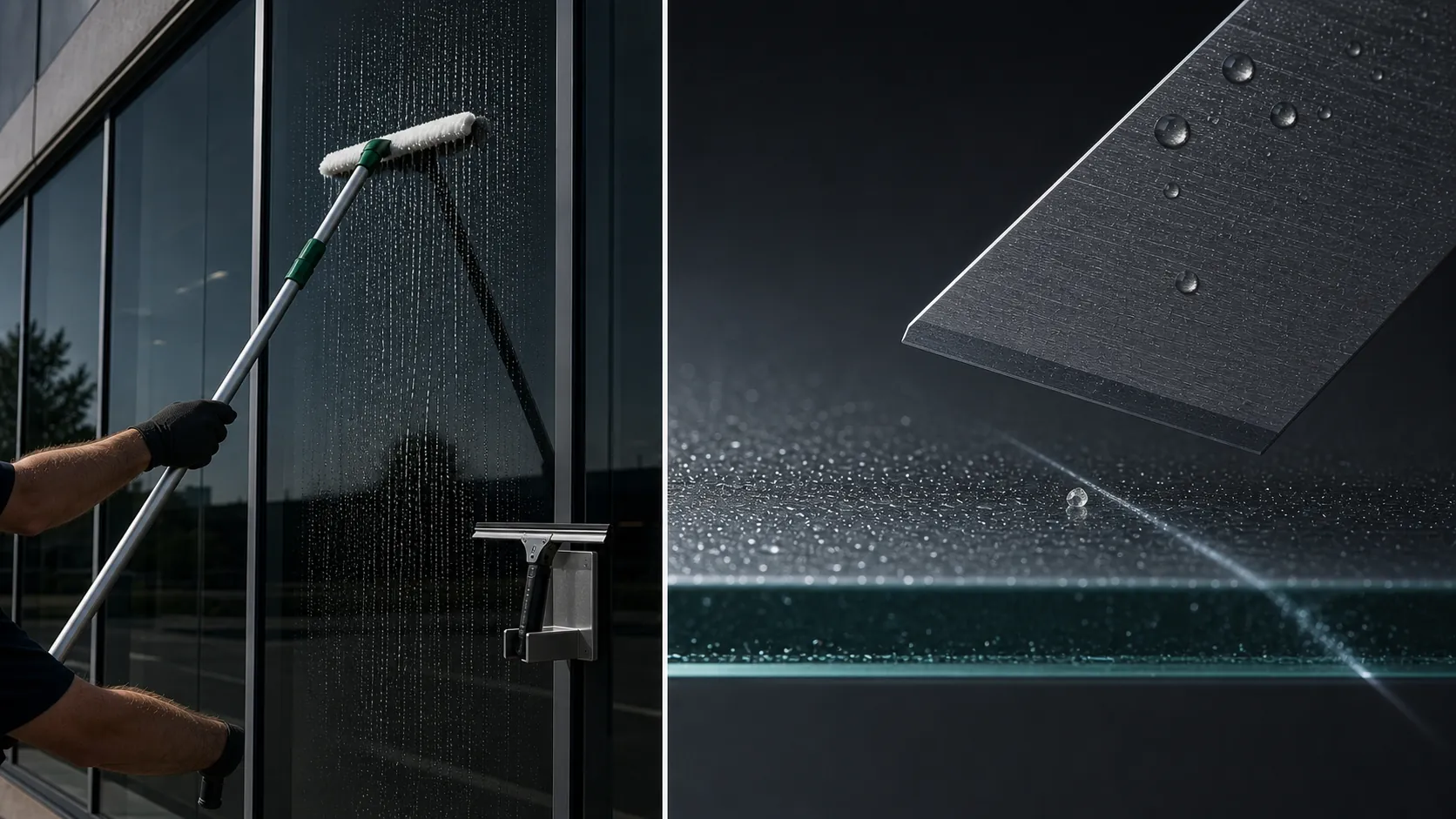
What happens before the glass reaches the building
Architectural glass is cut, edged, washed, heat treated when specified, fabricated into a larger assembly, shipped, stored, and installed. At each stage, glass grit, coating debris, metal, masonry particles, and other hard material can contact a surface. Clean equipment and protection reduce that risk.
During heat treatment, panes travel through equipment at high temperature. Particles present on a surface or processing equipment can become attached strongly enough that later cleaning does not behave like cleaning an ordinary loose grain. NGA's technical resources treat fabrication before heat treatment and cleaning of heat-treated surfaces as specific quality and maintenance subjects.
This does not mean every tempered pane contains harmful fabrication debris. Surface condition varies with glass, fabricator, equipment, maintenance, handling, storage, and jobsite exposure. A scratch is evidence of surface damage, not automatic proof of where a particle originated.
Tempering and coating are separate facts
A pane can be tempered and also tinted, laminated, coated, printed, filmed, or part of an insulating unit. The exposed face may be ordinary glass, a durable pyrolytic coating, a more sensitive coating, ceramic decoration, or aftermarket film. The temper mark does not identify that face.
The National Glass Association says razor blades must never be used on coated glass. When the coating location is uncertain, a blade test is not an identification method. Find specifications, labels, fabricator information, and product care instructions before escalating beyond compatible routine cleaning.
Why a scraper can create a repeating scratch pattern
A scraper does not have to be harder than glass to create damage. A hard particle trapped between the blade and pane can carry the concentrated load. As the blade moves, the particle can roll, fracture, or remain captured and cut one or several lines. A contaminated pad or towel can do the same on a smaller scale.
Returning a blade backward over collected material can move the debris in a new direction. Using a nicked, rusty, dull, or previously contaminated blade adds more uncontrolled edges. Working on dry glass increases friction and makes it harder to carry loosened material away.
| Pattern | What it may suggest | What it does not prove |
|---|---|---|
| Long parallel lines matching a tool path | A particle or damaged edge traveled with the tool | The origin of the particle or whether the glass was tempered |
| Short random scratches | Contaminated towels, pads, debris movement, prior trade contact, or several events | A single cleaning operation caused all marks |
| Marks beneath a bonded deposit | Damage may have occurred during installation, construction, or earlier removal attempts | The deposit itself is removable without further risk |
| Uniform optical pattern visible only through polarized light | Heat-treatment stress effects may be visible | Ordinary dirt or a scratch pattern |
Routine cleaning remains the starting point
NGA begins routine architectural-glass cleaning with clean water and a mild, non-abrasive solution. Wet the surface thoroughly, use clean compatible tools, rinse, dry, and inspect. Keep washers and towels away from sills or construction surfaces that can load them with grit.
Remove loose particles by lifting and flushing rather than dragging. If ordinary washing leaves bonded paint, mortar, silicone, adhesive, or another deposit, stop and identify that material. The decision to use a solvent, chemical, edge tool, or restoration process comes after glass and contaminant identification.
Scraping is a non-routine last option
NGA does not recommend routine scraping. Its 2023 cleaning paper describes a new blade in one direction on an affected area as a non-routine last option under controlled conditions. That narrow exception should not become a whole-building default.
- Confirm that the exposed face is not coated or filmed.
- Review the glass and construction documentation and communicate the added risk.
- Photograph a clean, dry representative area under useful daylight.
- Soak and remove loose material first.
- Use a new, undamaged blade and the direction allowed by the approved process.
- Stop frequently, clean the blade, and inspect the test area dry.
- Stop immediately at an audible or visible sign of scratching.
A safe test location is representative enough to reveal the condition and large enough to inspect. It should not hide at an edge where lighting makes scratches impossible to see. Test each glass construction present, including vision and spandrel areas when they differ.
Do not diagnose by sound alone
A blade can make sound over paint, sealant, glass texture, particles, or a dry section. Silence does not prove that no scratch occurred. Use sound only as one stop signal and rely on clean, dry inspection under several light angles.
Likewise, a fingernail test can find relief in an existing scratch but cannot date it or identify the cause. Compare pre-cleaning photographs, mapped deposits, tool paths, and damage visible after the routine wash.
Documentation protects the glass and the decision
- Record pane location, safety mark, coating or film clues, and accessible faces.
- Photograph reflected and transmitted conditions before non-routine work.
- Map construction deposits and existing scratch fields separately.
- Record the test tool, blade, solution, direction, lighting, and result.
- Keep an untouched comparison area.
- Obtain written agreement before expanding a risk-bearing method.
This record does not assign blame by itself. It establishes what could be seen, what was tested, and whether the proposed method is suitable.
When the pane is already scratched
Light and medium scratches on compatible glass may respond to a controlled glass-restoration test. Deeper correction removes more surrounding material and increases the risk of optical distortion. Coating loss, cracks, chips, edge damage, and internal insulating-glass defects are different conditions.
Choose among acceptance, limited polishing, full restoration, and replacement after viewing a representative test from normal positions. The goal is not to prove that every scratch can disappear. It is to select the correction that leaves the most useful and defensible glazing result.