Weld spatter on architectural glass: diagnosis, restoration limits, and replacement risk
Distinguish loose debris from fused hot-particle damage, protect glass before hot work, inspect the assembly, and test restoration only where strength, coatings, and optics permit.
The bright speck may be only the top of the defect
Hot particles from welding, cutting, and grinding can land on architectural glass during construction or repair. Some cool as loose debris. Others adhere, transfer metal, fuse into the surface, or leave a crater after the particle breaks away. A cluster that looks like ordinary construction grit can therefore contain heat damage, glass loss, coating damage, and a strength concern.
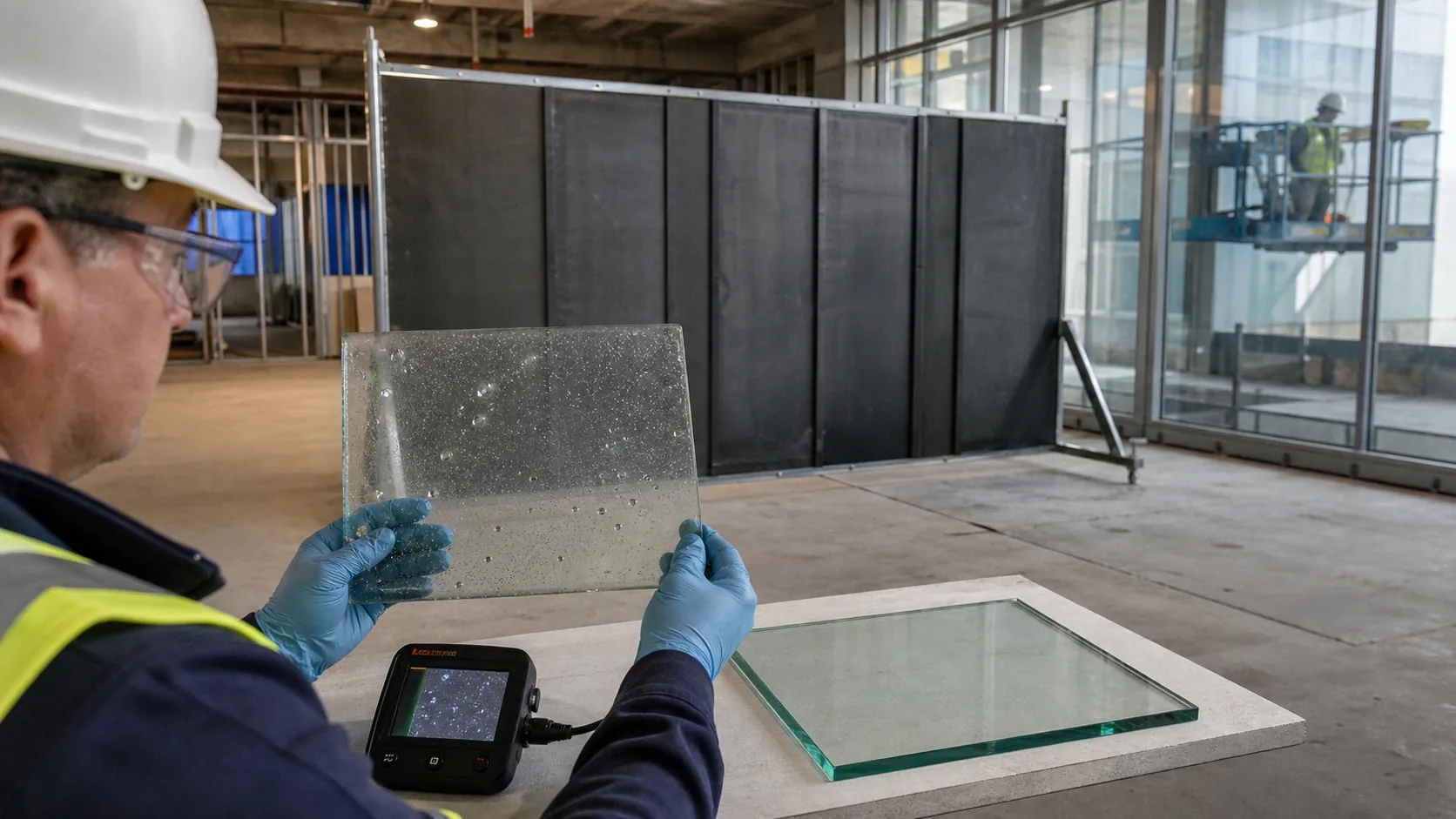
Do not pry at one speck to see whether it comes off. A fused particle can concentrate force into a small damaged area, and embedded metal can generate additional heat during mechanical restoration. First preserve evidence and identify the glazing.
Prevention belongs in the hot-work plan
Glass should be protected before welding, torch cutting, brazing, or abrasive work begins nearby. The hot-work permit and fire-prevention plan must still control sparks, heat, combustibles, fire watch, ventilation, and other hazards. Glass protection is one part of that plan, not a substitute for it.
Use a suitable noncombustible protective system selected for the process, particle path, temperature, distance, wind, access, and surrounding materials. It should intercept hot particles without transferring damaging heat, abrading the glass, trapping incompatible debris, or becoming a fire hazard. Keep the cover secure and spaced as its design requires. Plastic film, ordinary tarp, cardboard, or an unverified moving blanket is not automatically hot-work protection.
Inspect both sides of the barrier and the glazing at planned intervals. Sparks can travel through seams, around edges, and to lower lites. Work above a facade needs containment that accounts for gravity and wind, not just a small shield beside the welder.
Document before cleaning
Record the work area, trade activity, dates, likely particle direction, glass labels, lite dimensions, edge support, and visible condition. Photograph the field under broad and raking light with scale. Include unaffected adjacent glass for comparison.
Identify whether the lite is annealed, heat-strengthened, tempered, laminated, insulating, coated, fritted, mirrored, part of a door, guard, canopy, railing, or sloped assembly. Confirm which surface carries the damage. Between-pane particles, damaged internal coatings, and inaccessible faces cannot be corrected by polishing the weather face.
Classify what is actually present
| Condition | Typical clue | Handling boundary |
|---|---|---|
| Loose construction debris | Rests on the surface without a heat halo or crater | Remove only by the glass manufacturer's approved cleaning method |
| Metallic rub or transfer | Gray line or smear from cooler metal contact, sometimes resembling a scratch | Distinguish transferred material from a groove before restoration |
| Fused weld nodule | Raised reflective particle anchored to a dark or rough center | Do not pry or scrape; evaluate particle and underlying glass together |
| Thermal pit or crater | Depression, rough rim, missing particle, or ring visible in raking light | Map depth, density, and location; strength and optics may control |
| Crack or edge damage | Line radiating from a pit, chip at edge, damage near hole or notch | Stop work and obtain glazing or engineering review |
| Coating, film, or frit damage | Color shift, burned spot, peeling, or different reflection | Surface removal may make the defect larger and permanent |
A field may contain several categories. Cleaning away loose dust can reveal fused nodules below. Keep removed samples when chain of responsibility matters, but do not treat an unknown particle as harmless bare-handed debris.
Why casual scraping is a poor test
A razor can catch a raised particle and drag it across the pane. It can also break the nodule out of a crater, chip the rim, or scratch a coated surface. Aggressive scraping over heat-treated glass adds another damage mechanism to a surface that may already contain fabrication debris or hot-particle defects.
NGA construction guidance emphasizes protecting installed glass and warns that weld spatter and deep surface or edge damage may require replacement. The decision is not based only on whether the black dot can be removed. It includes what remains in the glass and what the lite is expected to do.
A restoration test has to answer more than clarity
Where the product, damage location, and safety role permit evaluation, select a representative test area that includes typical particle density and an undamaged boundary. The restoration system manufacturer should control tools, abrasives, sequence, working area, and temperature. Embedded metal may heat differently from glass, so temperature monitoring and short controlled passes matter.
Inspect the dry test from normal viewing positions, at angles, and under raking light. Record:
- whether particles were removed without spreading scratches;
- the pits or craters that remain and their density;
- optical distortion, haze, polish transition, or lensing;
- surface temperature observations and any unexpected heat response;
- coating, frit, film, edge, or seal changes;
- estimated labor and glass stock removal required for the full field.
A clear-looking spot does not establish that an entire lite can be restored. Dense fields require overlapping work, and the accumulated stock removal can create optical variation. The accepted viewing standard, distance, lighting, and sample size should be agreed before expansion.
When replacement review moves forward
Cracks, edge damage, deep pits, damage near holes or notches, uncertain safety glazing, exposed functional coatings, and large optically sensitive fields deserve glazing or engineering review. Doors, guardrails, overhead glass, canopies, and sloped glazing carry consequences that a cosmetic storefront lite may not.
Replacement also becomes sensible when the exact glass make-up cannot be established, an insulating unit has internal damage, or restoration would leave unacceptable optics. Match issues, access, occupant protection, and lead time still belong in that decision.
Close the construction loop
After assessment, mark the affected lites on elevations and connect the pattern to the hot-work area. Correct barriers, sequencing, and inspection before work resumes. Protect restored or replacement glass through the remaining construction period.
A professional glass-restoration review should leave a record of lite identification, damage map, test method, dry optical result, strength-related referral, acceptance, and prevention change. Simply removing the shiny specks leaves the most important questions unanswered.