Restore, repair, or replace damaged glass?
A decision matrix for separating surface defects from cracks, chips, seal failure, frame problems, coating loss, optical limits, and safety-glazing requirements.
First decide which part has failed
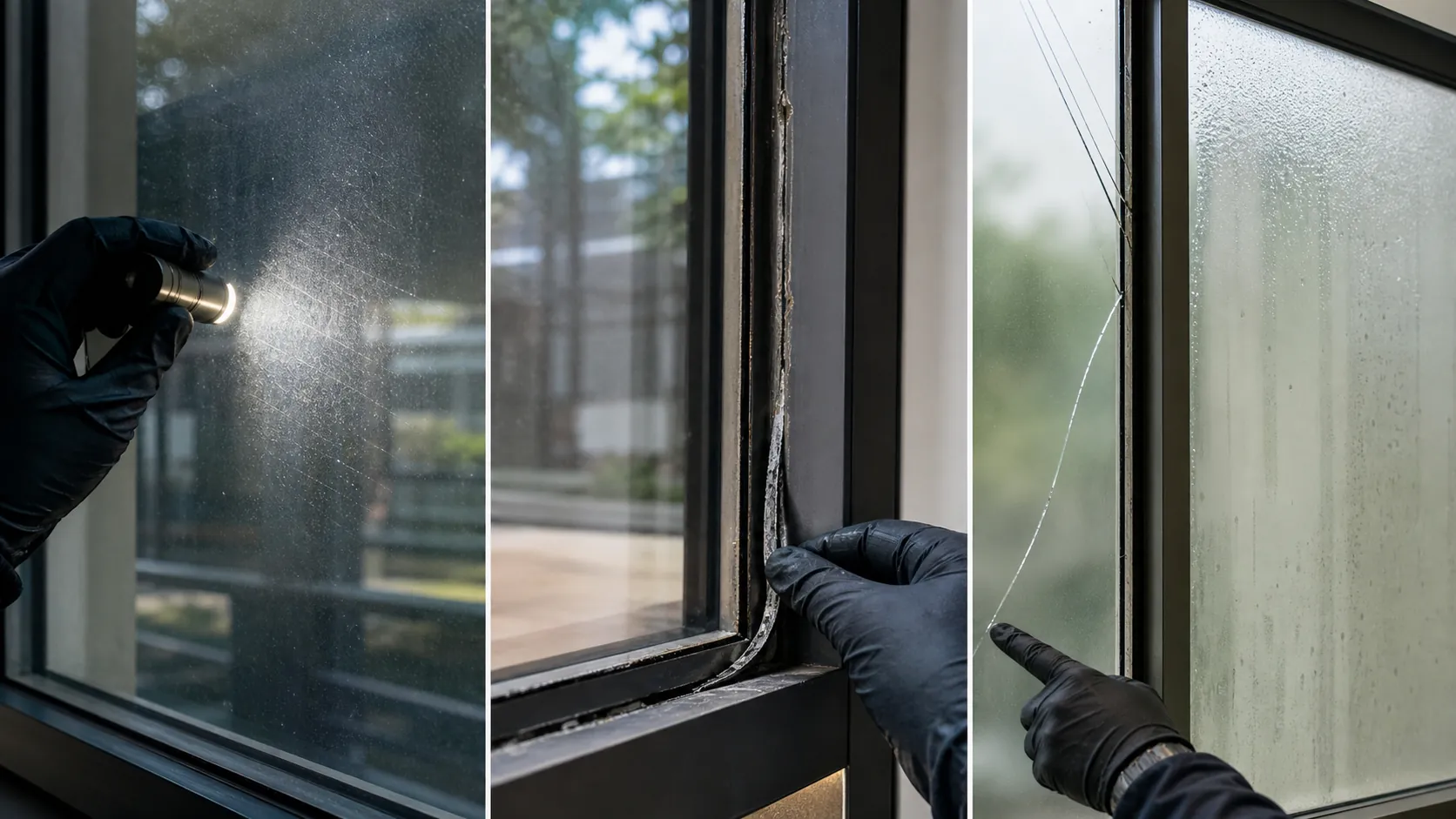
People often call every visible glazing problem damaged glass. That phrase can hide several different scopes. A scratch lies on a surface. Condensation between panes points toward an insulating-glass seal condition. A loose gasket belongs to the glazing system. A crack changes the integrity of the pane. Each needs a different trade decision.
Glass restoration removes a controlled amount of compatible glass to reduce a surface defect. It is not a structural repair, a seal replacement, or a way to grow back a missing coating. Correct classification prevents a cosmetic process from being sold as a solution to the wrong failure.
Document the assembly before pricing a remedy
Record pane dimensions, thickness if known, annealed or heat-treated status, lamination, insulating-unit construction, coatings, tint, frit, film, edge exposure, frame type, access, and safety-glazing location. Photograph the whole opening and the defect in dry light. Include a scale and note which surface carries the mark.
Inspect from normal occupied positions as well as close range. A defect that looks dramatic under a flashlight held against the pane may be inconspicuous in ordinary daylight. Conversely, a polished area can look acceptable up close yet show lensing across a storefront reflection. Agree on viewing conditions before choosing a finish standard.
Use the failure matrix
| Observed condition | Possible branch | Critical limit |
|---|---|---|
| Light surface scratches on known compatible bare glass | Test restoration or accept | Must control heat, removal, clarity, and distortion |
| Mineral residue or early surface reaction | Identify deposit, test cleaning, then consider restoration | Do not assume every white mark is removable scale |
| Deep scratch or gouge | Representative restoration test or replacement comparison | More depth requires a wider blend and increases optical risk |
| Crack, running crack, impact cone, or missing glass | Isolate hazard and obtain glazing replacement assessment | Cosmetic polishing does not restore pane integrity |
| Edge chip or damaged hole/notch | Glazing professional and manufacturer review | Edges and penetrations carry stress; do not polish casually |
| Fog or moisture between sealed panes | Insulating-glass or window-system diagnosis | Exterior surface restoration does not repair the perimeter seal |
| Peeling film or failed applied coating | Film/coating specialist, removal, reapplication, or replacement | Glass polishing may remove more of the layer |
| Loose stops, failed sealant, displaced gasket, corroded frame | Glazing or frame repair | The support and weather seal are outside cosmetic glass correction |
When surface restoration is a real candidate
A suitable candidate has a defect on an accessible glass surface, a known compatible substrate, enough surrounding area to blend the correction, and no condition that requires preserving an exposed coating or film. The operator must be able to manage water, slurry, heat, edges, seals, and nearby finishes.
Make a small representative test panel. Use the selected abrasive sequence and monitor glass temperature according to the system instructions. Remove the coarser pattern with each finer step rather than jumping directly to polish. Clean and dry the test, then inspect for defect reduction, clarity, haze, waviness, and changed reflection.
Approval should describe the result, not just the process. For example: the scratch is not visible from a stated distance under agreed daylight, and the test shows no objectionable distortion from designated viewing positions. Exact expectations vary by project.
When limited acceptance beats aggressive correction
Removing a deep defect means removing surrounding material until the surface reaches the bottom of that defect. A narrow, deep excavation can act like a lens. Expanding the blend reduces the abrupt transition but increases the worked area, time, and optical exposure.
If the mark is visible only under inspection lighting, lies outside the normal sightline, or would require an excessive blend near an edge, acceptance may preserve a better overall pane. A test panel lets the owner compare the original defect with the likely optical tradeoff before authorizing the full area.
What belongs to repair rather than restoration
Glazing repair may include replacing sealant, gaskets, stops, setting blocks, hardware, or frame components, depending on the system and the qualified trade. These tasks can affect water management, glass support, clearances, and movement. They should follow system documents and applicable code, not a cosmetic polishing procedure.
Do not drill a crack, grind an edge chip, inject a substance, or modify safety glazing as an improvised field fix. Secure the area when breakage could fall or be contacted, then obtain a qualified glazing assessment.
Replacement has more inputs than glass price
Replacement becomes the likely path for broken panes, disqualifying edge damage, failed insulating units, unavailable surface coatings, incompatible restoration candidates, or optical results the owner cannot accept. It may also be required to maintain safety glazing, fire-rated construction, structural performance, energy characteristics, or a product warranty.
Compare lead time, access, interior disruption, disposal, temporary protection, matching tint or reflectance, frame condition, and the risk of damaging adjacent finishes. A replacement lite that does not visually match its elevation can create a new problem even when technically sound.
Ask six questions before authorizing work
- Is the condition on the glass surface, inside the unit, at an edge, or in the frame?
- Is the exposed surface bare compatible glass, or does it carry a coating or film?
- Does the condition affect safety, structural behavior, weather seal, or only appearance?
- What does a representative test look like when fully dry from agreed positions?
- What optical change and residual defect can the owner accept?
- Does repair or replacement require the glass fabricator, system manufacturer, engineer, or code authority?
A documented glass-restoration evaluation should make the no-go conditions as clear as the workable ones. That boundary is what turns polishing from a gamble into a controlled option.