Post-construction glass contamination
How to identify and test paint, mortar, silicone, stickers, adhesive, fabrication debris, and permanent construction damage without turning cleanup into scratches.
Post-construction cleanup begins with evidence
A new building can place several unrelated materials on one pane: drywall dust, paint droplets, concrete runoff, adhesive, sealant, metal particles, and ordinary soil. Treating all of them as "construction debris" hides the decisions that matter. Each contaminant has its own bond, chemistry, particle hardness, and risk to glass, coatings, frames, and sealants.
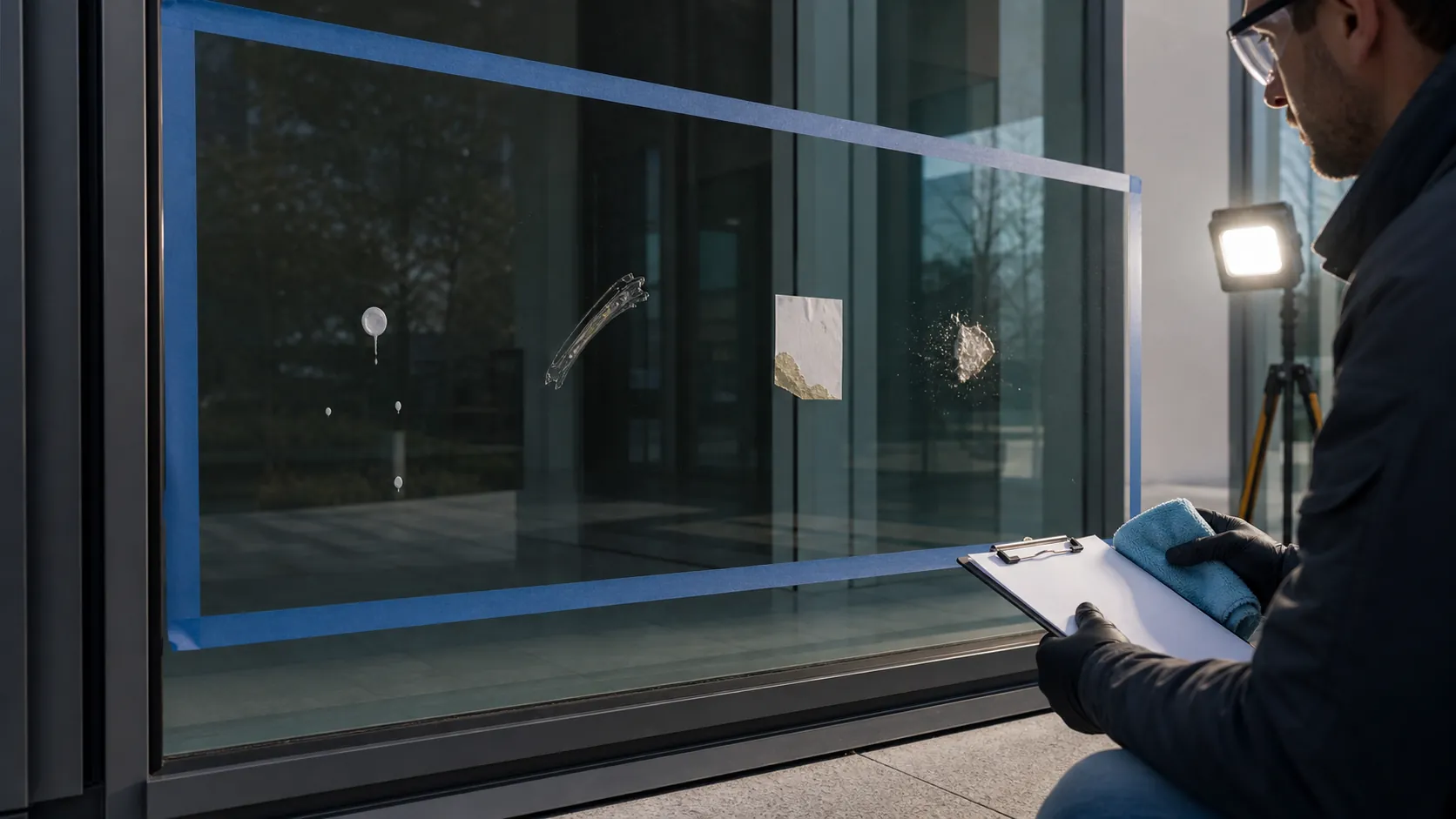
Document the dry pane before moving debris. Photographs, lighting, pane identification, and a mapped test area help separate pre-existing damage from anything the cleanup process changes. That record is especially important when several trades worked beside unprotected glass.
Protection during construction is the primary control
The National Glass Association advises protecting installed and stored glass from cement, paint, varnish, adhesives, welding, and other construction conditions. Long schedules may require interim cleaning because protective films and barriers have service limits, and debris becomes harder to remove after repeated wetting, heat, and ultraviolet exposure.
Protection must be compatible with the glazing. Tape and film adhesive can weather onto glass, coatings, frames, and sealants. A sheet that traps alkaline runoff against a pane can create a different problem. Follow the protection manufacturer's placement and removal dates, inspect it during the project, and replace damaged coverage.
Start with the glass construction
Record whether available information identifies clear or tinted glass, annealed or heat-treated glass, laminated construction, an insulating unit, decorative treatment, aftermarket film, or an exposed Low-E or reflective coating. Check labels, safety marks, specifications, invoices, manufacturer documents, and the appearance of glass edges. A visual guess is not proof.
Coated glass has the strictest boundary: NGA states that razor blades must never be used on coated glass. Abrasive pads, solvents, acids, alkaline cleaners, and polishing systems also need surface-specific approval. The frame, gaskets, structural silicone, setting materials, stone, and metal below the pane may impose tighter limits than the glass itself.
Map the contaminants before selecting tools
| Observed material | Useful clues | Main risk |
|---|---|---|
| Paint or coating droplets | Color, overspray pattern, flexible or brittle film, project product records | Solvent can attack film, coating, sealant, or frame finish; hard removal can scratch |
| Mortar, grout, cement, or masonry runoff | Gray or white crust, splash shape, vertical run, gritty particles, nearby trade activity | Alkaline exposure, abrasive aggregate, etched surface, adjacent stone or metal reaction |
| Silicone or sealant | Raised bead, elastic smear, glossy haze, location beside glazing joints | Smearing a thin film, cutting a gasket, scratching while chasing cured residue |
| Sticker and tape adhesive | Paper or film edge, rectangular weathering pattern, tacky or hardened residue | Unknown solvent compatibility, trapped grit, old film that tears into small pieces |
| Fine hard particles | Not always visible; may be associated with heat treatment, grinding, masonry, or metal work | A blade or pad can drag a particle across the surface and create repeating scratches |
| Weld spatter, deep scratch, chip, or crack | Fused pits or beads, groove, impact point, edge origin, reflected-light change | Permanent surface or structural damage, not ordinary removable soil |
Do not identify a deposit from color alone. White material might be joint compound, paint, mineral scale, cement, sealant haze, or a chemically altered glass surface. Project submittals and conversations with the trade that created the condition often provide better evidence than another cleaner.
A controlled test sequence
- Photograph and map. Record the whole pane, representative deposits, scratches, edges, coatings, and adjacent materials under useful daylight and grazing light.
- Remove loose dry hazards. Use a method that lifts rather than drags sharp particles. Keep contaminated brushes and towels away from clean glass.
- Perform routine cleaning. Soak with clean water and a mild, non-abrasive solution permitted for the glass. Remove ordinary soil before judging bonded material.
- Dry and inspect. Wet glass hides haze, scratches, and chemical alteration. Rephotograph the clean baseline.
- Select one contaminant. Test a representative, agreed area with a method designed for that material and surface.
- Control every variable. Record product, dilution, dwell, temperature, tool, direction, pressure, rinse, and waste control.
- Stop and compare. Clean and dry the test area before expanding. Check glass, reflection, coating, sealant, frame, and runoff path.
A successful spot does not authorize the same method on every pane. Glass construction, exposure, debris, prior work, and surface temperature may change across an elevation.
Paint requires product identification
Fresh water-based paint behaves differently from cured industrial coating, two-part material, spray paint, or overspray baked by sun. Ask for the product name and cleanup instructions. If the paint manufacturer names a remover, that does not establish compatibility with the glass assembly. Both sets of instructions must agree.
Soften compatible material before mechanical action. Keep the area wet when the approved method requires it and isolate removed fragments so they do not travel beneath a washer or blade. A solvent test belongs in a controlled location with ventilation, personal protection, fire control, and protection for gaskets, films, frames, and interiors.
Mortar and cement combine chemistry with grit
Cementitious splashes contain hard aggregate and alkaline material. Scrubbing a dry splash can move abrasive particles over the pane. Flooding it with a reactive cleaner without runoff control can affect metal, stone, sealants, landscaping, and the glass surface.
Do not publish or improvise a universal acid recipe. NGA's routine cleaning guidance excludes acids, with particular concern for muriatic or hydrochloric and hydrofluoric acid. A project-specific non-routine process requires the glass fabricator or manufacturer, product instructions, a test panel, safety controls, and a plan for adjacent materials and wash water.
If the deposit releases but a dull run remains, the surface may already be etched. Repeating chemical removal cannot rebuild altered glass. The next question is whether a controlled restoration test can improve the optics without unacceptable distortion.
Silicone has a raised portion and a thin film
A cured bead can sometimes be separated from a compatible smooth surface, while the remaining silicone film smears under a towel and becomes more visible in side light. Treat the bead and haze as separate steps. Identify whether the material is construction sealant, glazing silicone, caulk, or another polymer before choosing a solvent or edge tool.
Do not cut toward a gasket or structural seal. A scratch in the black glass border, damage to a coating, or a notch in the weather seal may be harder to repair than the original residue. Use clean consumables and change them when silicone transfers back to the glass.
Labels, tape, and protective film age into a different job
Paper labels can hold water while the adhesive beneath stays bonded. Plastic film can become brittle, tear into narrow pieces, or leave a rectangular difference in weathering. Heat, ultraviolet exposure, adhesive type, and removal deadline change the process.
Begin with the film manufacturer's removal instructions and determine whether the exposed face has a coating or aftermarket tint. Work from a small lifted edge only when the process is permitted. Collect adhesive instead of spreading it. Reinspect after the surface is fully dry because a thin film can disappear while wet.
Why fabrication debris changes scraper risk
Heat-treated glass surfaces can carry hard particles created during fabrication, and construction work can add other sharp material. The presence and amount cannot be established by calling the pane tempered. Not every heat-treated pane has problematic debris, and a scratch does not by itself prove a fabrication defect.
NGA does not recommend routine scraping. It describes a new blade used in one direction on an affected area as a non-routine last option under controlled conditions, and never on coated glass. Before any permitted blade test, establish the glass, consult construction and manufacturer documents, wet the area, isolate loose particles, and listen and inspect for a change. Stop at the first evidence of scratching.
Moving a contaminated blade backward across collected debris increases the chance of dragging a hard particle. A dull, rusty, nicked, or previously used blade is not a conservative choice.
Some construction conditions are damage, not dirt
Weld spatter can fuse hot metal to glass, create pits, and reduce strength. Deep scratches, cracks, and edge damage can affect structural performance. NGA's construction protection paper identifies these as conditions that may require glass replacement and consultation with the glazing contractor and fabricator.
Polishing can address selected surface scratches or etching on compatible glass, but it removes material and may change optics. It cannot replace missing coating, repair a crack, restore an edge, or correct fog inside an insulating unit. The test panel should compare restoration risk and cost with replacement.
Close the project with a pane-level record
Record which panes were cleaned routinely, which received a non-routine test, the approved method, remaining damage, protected materials, and any replacement recommendation. Photograph the dry result from the original positions. Keep product names, lot information, safety data, and fabricator correspondence with the closeout.
A responsible post-construction glass scope does not promise that every mark is removable. It distinguishes soil, bonded contamination, altered surface, and structural damage before pricing the work.