Why a window still looks dirty after cleaning
Locate the condition by glass surface, light, angle, moisture, and timing, then distinguish residue from opposite-side soil, condensation, seal failure, scratches, mineral alteration, coatings, and reflections.
Another cleaning pass may be the wrong test
A pane can be clean to the touch and still show haze, spots, lines, or a gray cast. Before changing soap or reaching for a blade, locate the visible condition. It may be on the opposite face, between sealed panes, in a coating, under a film, on a screen, or in the reflected scene.
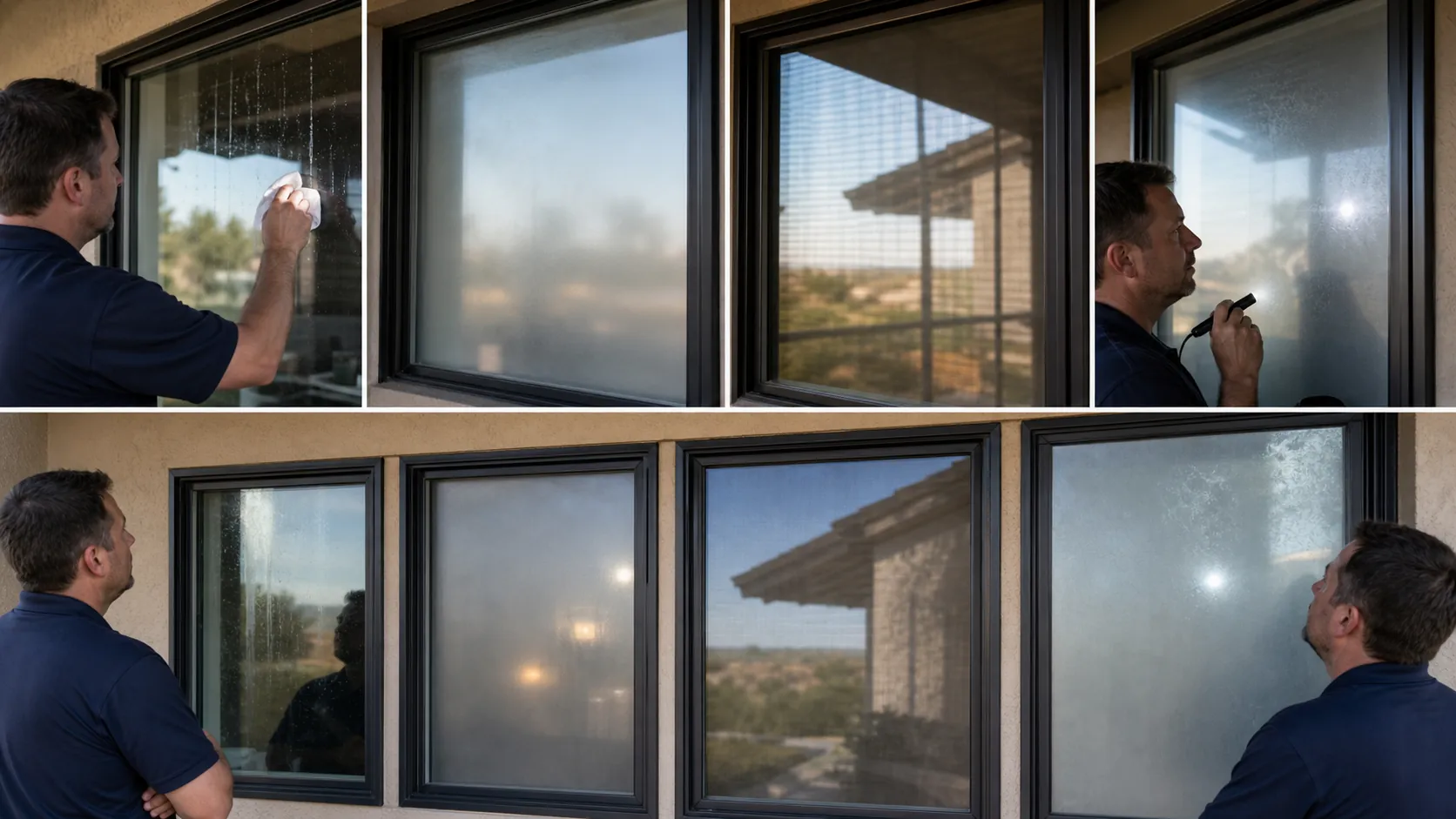
A stronger chemical only helps when chemistry is the problem and the surface permits it. Repeating aggressive work on a seal failure or scratch adds risk without changing the cause.
Wait for a dry, stable view
Inspect after rinse water and detailing moisture have evaporated. Look from the normal room or exterior position, then change angle and distance. Check under broad daylight, a neutral interior background, and a controlled low-angle light. Record whether the mark moves, disappears, or changes character.
Time matters. Exterior condensation may appear after a cool clear night and evaporate later. A low sun can reveal fine scratches that a gray sky hides. Reflections from trees, screens, interior shades, and nearby buildings change as the observer moves.
Find the surface
Architectural glazing can have one pane, laminated plies, an insulating space, multiple coated faces, applied film, and removable accessories. Do not call a condition reachable until its location is known.
- Inspect the accessible face with clean dry light at an oblique angle.
- View the same point from the other side when access is safe.
- Move your head slightly. A feature that shifts relative to its reflection or a surface mark may lie on another plane.
- Temporarily remove a screen, grille, or shade only through its product procedure and compare the view.
- Mark the apparent location on a pane diagram without placing adhesive on a sensitive surface.
A fingernail or metal point is not a universal depth test. Exposed coatings and films can be damaged by casual probing.
Classify what remains
| Appearance | Useful clue | Likely next step |
|---|---|---|
| Smear or rainbow film that changes after a clean-cloth pass | Surface residue from solution, towel, cooking film, aerosol, sealant, or frame runoff | Identify the residue and use a compatible controlled cleaning test |
| Lines that follow squeegee strokes | Blade nick, grit, dry section, dirty solution, insufficient overlap, or water pulled from an uncleared edge | Correct tool and technique, then test one section |
| Fog or droplets between sealed panes | Cannot be touched from either accessible face; changes with temperature | Evaluate the insulating-glass unit and warranty or replacement options |
| Haze only on certain mornings | Moisture is on the interior or exterior face and later evaporates | Assess humidity, dew point, ventilation, drainage, and surface temperature |
| White spots or dull patch that remains after deposit removal | Mineral residue may have altered the glass or coating | Perform a restoration test after correcting the water source |
| Fine lines visible in raking light | Scratch, fabrication debris, abrasive cleaning damage, or coating mark | Document before any further abrasive work |
| Grid, mesh, double image, or dark band that shifts with position | Screen, shade, reflection, coating, glass make-up, or optical distortion | Compare with accessories removed and product records available |
Surface residue usually has a pattern
Detergent film often covers a broad area or follows drying paths. Detail-towel contamination concentrates at edges and corners. Frame oxidation or dirty gasket runoff begins above the mark. Silicone and adhesive transfer may show a sharp smear or fingerprint. Hard-water spots repeat where sprinkler droplets dry.
Use a fresh applicator, clean solution, verified rinse water, sound squeegee rubber, and separate lint-free detailing cloth for a small test. Protect frames and finishes. If the test changes the residue, document the successful method before expanding it. If it does not, stop adding chemistry.
Condensation location changes the diagnosis
Interior condensation forms when humid indoor air meets glass below its dew point. Exterior condensation can form on efficient glazing when the outer surface cools below outdoor dew point. Andersen notes that this exterior moisture may appear as haze and usually evaporates during the day.
Condensation between panes of an insulating unit points to a seal or unit condition. Pella identifies seal failure as the primary reason for between-pane fog. Cleaning the room-side and weather-side surfaces cannot reach that moisture. Document the affected lite, temperature pattern, edge seal appearance, warranty information, and whether replacement glazing is available.
Scratches and mineral alteration are not soil
A scratch scatters low-angle light and may look like a gray hair or wipe mark. A group of fine scratches can look like haze. Mineral deposits can begin as removable residue and progress to a chemically or mechanically altered surface. Polishing marks, coating damage, and acid contact can also leave a dull region.
Do not keep scraping a line to see whether it disappears. Identify glass type, heat treatment, coating surface, film, and prior construction exposure. Photograph under repeatable light and route the condition to a glass-restoration assessment when ordinary cleaning no longer changes it.
The opposite side is easy to miss
French panes, storm windows, double-hung sashes, balcony glazing, skylights, and interior partitions can limit access to one face. Soil on the inaccessible face may appear close enough to wipe. Mark a point with a removable reference placed only on an approved nearby frame surface, then compare from both sides.
Also inspect the screen. Dust, pollen, mineral residue, torn mesh, and uneven solar screen density can cast a dirty pattern onto clean glass. Reinstall only after both screen and window are dry.
Use a short diagnostic record
- pane and apparent surface
- wet or dry condition and time observed
- light, angle, distance, and accessories present
- cleaning method already used
- small compatible test and result
- photos plus next owner, glazing, cleaning, or restoration action
The useful outcome is not another unexplained pass. It is a location and a cause category. Once those are known, ordinary cleaning, humidity control, component service, restoration, or replacement can take the correct scope.