Water-fed pole technique from the ground up
Select the brush, control purified water, clean frames before glass, agitate corners, rinse methodically, route hose, manage pedestrians and power hazards, and inspect dry.
A long pole moves the work, not the hazards
Water-fed poles let a trained cleaner work many elevated windows while remaining on the ground. They also place a long object near façades, signs, trees, traffic, pedestrians, and sometimes electrical conductors. Hose crosses the site, paving becomes wet, and the operator often looks upward instead of at the next step.
Plan the ground before extending the pole. The method is productive when filtration, brush, pole, water flow, work zone, movement, and inspection operate as one system.
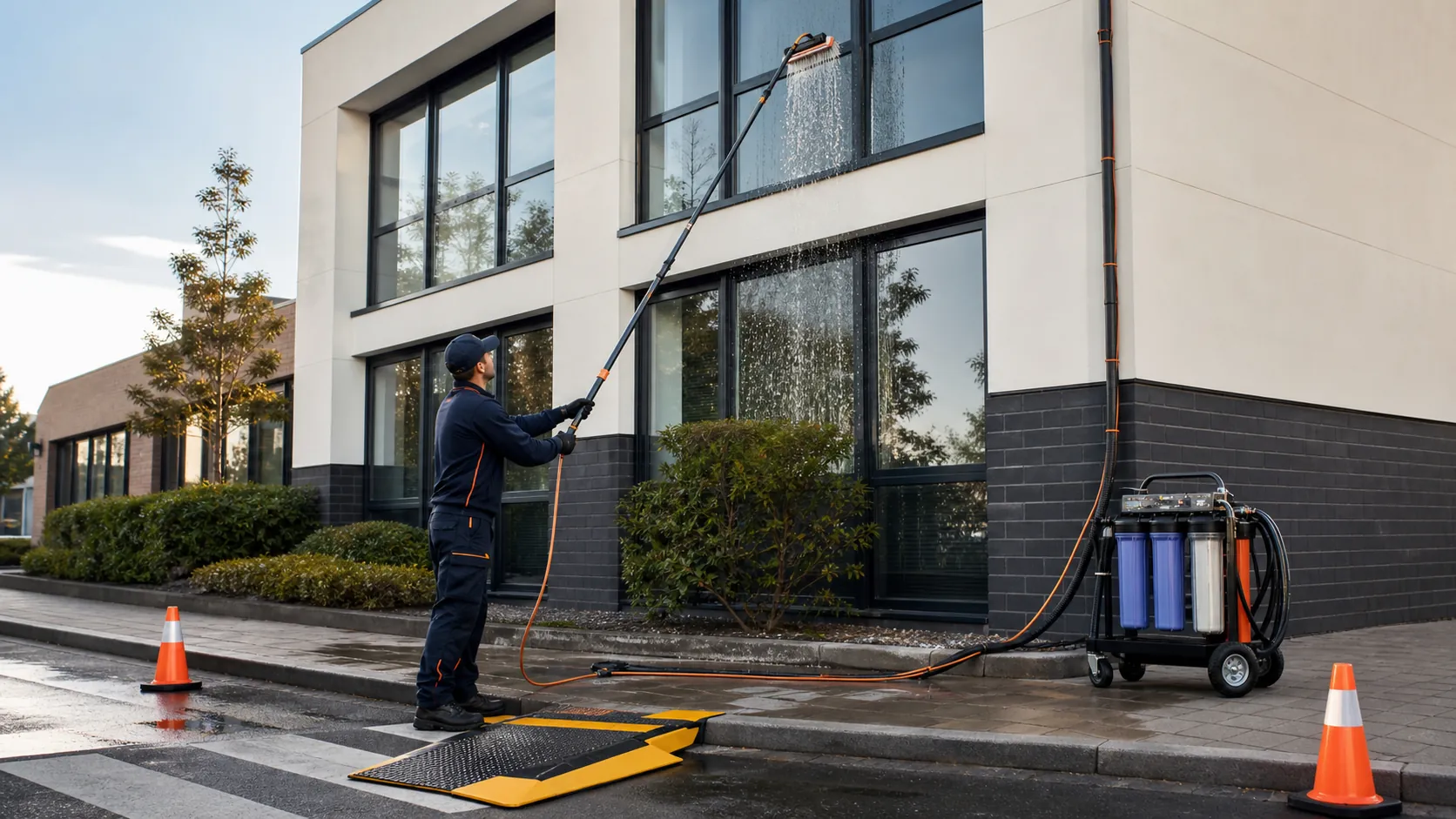
Start with a site and electrical assessment
Walk the pole route while looking both up and down. Locate overhead lines, service drops, transformers, building-mounted electrical equipment, traffic, roof edges, fragile façade elements, loose screens, open windows, signs, awnings, uneven paving, doors, and drainage. Establish the required clearance and work controls under applicable safety rules. Do not rely on a carbon or composite pole being electrically safe.
Separate the public with barriers and signs appropriate to the location. Route hose along an edge where possible. At an unavoidable crossing, use a suitable hose protector and active control rather than a loose loop. Mark wet walking surfaces and prevent pooling or freezing.
Verify that the window belongs on the route
Identify glass, exposed coatings, film, decorative faces, frames, gaskets, vents, hardware, and surrounding materials. Close and latch operable units when their manufacturer directs. Exclude broken panes, failed seals, loose trim, open electrical penetrations, active leaks, unfinished wood, and any window whose construction cannot tolerate the planned water.
Water-fed cleaning is not a way to ignore a frame defect. Photograph open joints and weak components before work. A brush can dislodge loose material, and water can reveal an existing leak inside.
Deliver water that the process can use
Measure output quality at the point defined by the treatment system, and verify flow at the brush. A low TDS reading is useful operating evidence, but it does not prove the brush is clean or the pane has been fully rinsed. Treatment performance, hose contamination, frame runoff, incompatible chemistry, and residual deposits remain separate variables.
Set the filtration unit upright on stable ground, secure carts and vessels, inspect connections, and keep the discharge route controlled. Protect the system from freezing and stay within its pressure and temperature ratings. Turn off supply when the system is not in use.
Select the brush for the exposed materials
| Condition | Brush question | Reason |
|---|---|---|
| Routine glass and sound frames | Does the manufacturer approve the bristle and stock for both? | The brush contacts more than glass |
| Deep frames or projecting sills | Will stock shape and angle reach corners without striking seals? | Missed ledges can release dirty water later |
| Textured or decorative face | Is the bristle non-abrasive and approved for that finish? | Texture can retain grit and show changed sheen |
| Heavy loose soil | Can the brush be rinsed before it transfers particles? | Loaded bristles can drag contamination across later panes |
| Oil, sealant, paint, or mineral bond | Is water-fed routine cleaning the correct method at all? | Specific contamination may require a separate test and tool |
Keep dedicated, clean brush stock for glass work. Inspect bristles and jets before each route. Remove grit using the brush maker's method; do not continue merely because water is flowing.
Clean upper frames before the pane
On the first service or when frames are dirty, wet and agitate the upper frame, sides, joints, and accessible ledges before the final glass pass. Work top to bottom so displaced soil does not fall onto finished panes. Rinse the brush when frame oxidation, insect debris, sand, or deteriorated sealant loads the bristles.
Do not repeatedly flood open weeps, vents, failed gaskets, or frame joints. Frame-first means controlled removal of soil from a sound assembly. It does not mean forcing water into every opening.
Agitate with a repeatable path
- Set the brush square enough that bristles make useful contact without crushing.
- Scrub the top corners and perimeter, where atmospheric soil often accumulates.
- Cover the central pane with overlapping vertical and horizontal movement.
- Use controlled pressure from body position rather than bending the pole sharply.
- Keep the stock and fittings from striking glass edges, mullions, or protruding hardware.
- Re-agitate named stubborn areas only after identifying the residue.
At greater extension, small movements at the hands become large movements at the brush. Slow the pace. Shorten the pole when moving between openings rather than swinging a fully extended pole across the façade.
Rinse from clean top water to the lower edge
The final rinse should carry loosened soil and frame residue down and off the pane. Depending on the approved brush and jet configuration, rinse with the bristles just off the glass or by the method specified for the system. Use a deliberate top-to-bottom pattern with enough clean flow to replace contaminated water, especially beneath upper gaskets and mullions.
Do not touch a newly rinsed pane with a dirty brush, pole hose, hand, or frame runoff. Watch for water released from projecting caps and horizontal joints. If dirty drops reappear, clean the source and repeat the affected pane rather than adding a random rinse from the ground.
Manage the pole and hose as the route changes
Keep the hose behind or beside the operator, out of the stance and away from vehicle lanes. Move it by walking back to the obstruction instead of snapping it around corners. Protect it from sharp edges, doors, hot exhaust, and crushing. A helper or spotter may be needed where the operator cannot watch both the brush and the public route.
Use balanced posture, change hand positions, take breaks, and avoid overreaching. Lower the pole in a controlled clear zone before adjusting the brush angle or jet. Never lower or rotate it toward electrical lines, people, glazing, or moving vehicles.
Let a dry pane grade the technique
Pure-water work is left to dry, so wet appearance is not the acceptance test. Revisit representative panes after drainage and evaporation. Inspect top corners, under gaskets, side edges, and the lower band for spots, frame runs, missed soil, brush marks, or residues that did not respond.
| Dry result | Check first |
|---|---|
| Spots across the whole pane | Output water, rinse volume, contaminated brush, airborne spray |
| Runs from the top | Upper frame and gasket still releasing soil |
| Dirty lower band | Insufficient final rinse or water trapped on sill |
| One repeated missed corner | Brush angle, stock shape, operator position |
| Clouding unchanged by cleaning | Mineral reaction, coating, internal moisture, or another non-soil condition |
Record the treatment reading, brush, flow setup, route, weather, and dry result. A professional window-cleaning program can then repeat a proven method instead of rediscovering it at every visit.