
Sprinkler overspray on windows: remove the deposit and stop its return
Trace the irrigation zone and spray path, correct the source, identify what the water left on each glass and frame surface, then use a dry test to choose cleaning or restoration.
The sprinkler must be part of the window inspection
A white band along the bottom of a storefront is often described as hard water before anyone watches the irrigation system run. That skips the most useful evidence. A leaking valve, tilted spray head, wrong nozzle, wind-driven arc, or runoff from irrigated masonry can wet different surfaces and leave different residues.
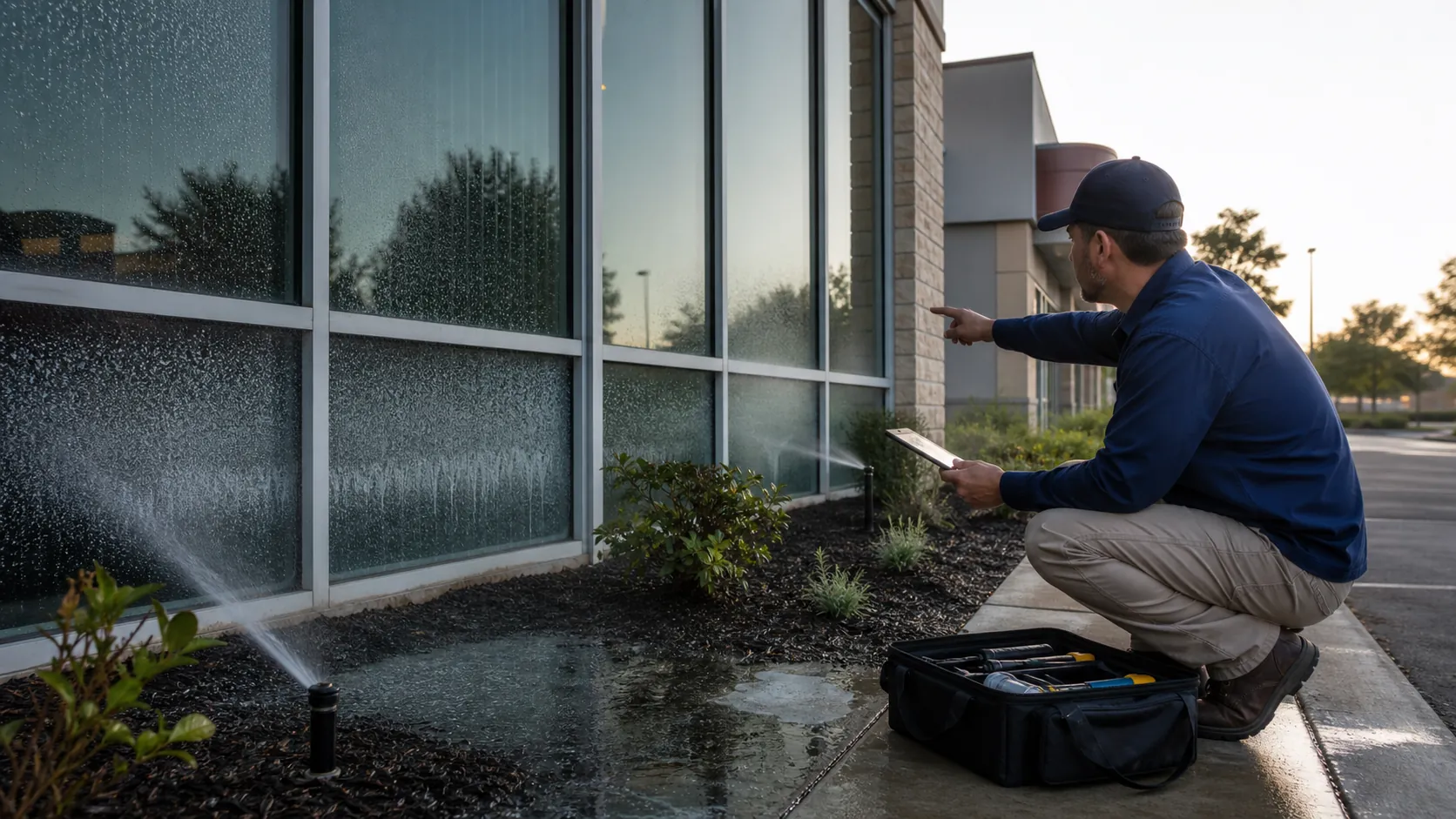
Cleaning the glass while the source continues creates a short-lived result and concentrates another layer after every cycle. Start with the irrigation event, then diagnose the dry surface.
Run the zone under the conditions that caused the complaint
Ask for controller schedules, zone maps, recent nozzle work, water-source information, and photographs of the wet facade. Observe each affected zone through a full cycle. Early morning wind can differ from afternoon conditions, so a calm midday test may miss the actual path.
- mark every head that reaches glass, frame, gasket, screen, sealant, stone, or painted metal;
- record start and stop points, direction of rotation, throw, misting, pressure changes, leaks, ponding, and wind;
- check whether a head is below grade, tilted by roots, blocked by plants, fitted with the wrong nozzle, or rotating past its intended arc;
- follow water from upper ledges and masonry, because the liquid reaching glass may not come directly from a head;
- compare the wet path with the dry deposit map.
Photograph from fixed positions and note which panes remain protected. A sharp horizontal deposit line can correspond to spray height. Vertical streaks may come from a frame or wall that was wetted above the glass.
Fix coverage without creating a dry landscape zone
Sprinkler adjustments are model-specific. Hunter, for example, documents separate arc and radius procedures for its products and notes that some nozzles permit only limited radius reduction. Turning a screw beyond the intended range can distort distribution without putting water where the plants need it.
Identify the manufacturer and exact head or nozzle before changing anything. The correction may be a realigned body, proper arc, smaller-radius nozzle, pressure-regulated body, repaired valve, raised or relocated head, different run time, drip conversion, or revised planting. Have an irrigation professional verify coverage after the facade is no longer in the pattern.
Do not merely aim the stream at a walkway, neighboring property, electrical equipment, or a different part of the building. Record the final wet test and keep it with the window-maintenance file.
Read what the water left behind
| Dry condition | Useful clue | Likely next step |
|---|---|---|
| Loose soil or plant debris | Moves without grinding and has no bonded edge | Lift solids, then perform routine compatible cleaning |
| Soluble salt film | Changes substantially with fresh water in a small test | Controlled fresh-water rinse and compatible cleaning |
| Mineral scale | White rings, drops, or band remains after routine cleaning | Identify glass and make a mineral-removal test |
| Corrosion runoff | Color or pattern begins at metal, fastener, frame, or screen | Correct the material source and test both finish and glass |
| Coating or finish change | Reflectance, gloss, color, or wetting differs after deposit is gone | Consult product manufacturer; cleaning cannot replace material |
| Etched or weathered surface | Haze, pits, or roughness remains clean and dry | Qualified restoration test or replacement evaluation |
One pane can contain several layers. Mineral may sit over oily traffic film, and corrosion from an aluminum screen can add a darker trail. A single acid or abrasive pass cannot be assumed to treat them safely.
Identify the glass and assembly before the test
Record whether the lite is monolithic, laminated, insulating, annealed, heat-treated, tinted, fritted, patterned, or coated. Find the exposed surface number and any low-maintenance exterior coating. Inspect frame finish, gaskets, sealants, screens, weep paths, insulating-glass edges, cracks, chips, and prior scratches.
NGA recommends a small test and careful inspection under useful daylight before broad cleaning. Product instructions can be more restrictive. A tool accepted on ordinary uncoated glass may damage an exposed low-emissivity or self-cleaning surface.
Make the test answer one question at a time
- Select a representative area within the deposit and an adjacent control.
- Protect frame, gasket, sealant, stone, plants, occupants, and drainage.
- Remove loose grit without rubbing it across the pane.
- Soak with clean water and a mild nonabrasive solution accepted for the glass.
- Agitate with a compatible washer or cloth, rinse, and dry completely.
- Inspect with broad and raking light. Record what disappeared and what remains.
- If bonded mineral remains, test only a product and dwell accepted for that surface, then neutralize or rinse exactly as directed.
- Stop if gloss, color, coating, texture, frame finish, or sealant changes.
A wet sample can look clear because water fills microscopic texture and reduces contrast. Do not approve the result until it is dry and seen from normal interior and exterior positions.
Know when cleaning has reached its limit
If verified deposit is removed but haze or pits remain, the water may have altered the surface or exposed older damage. More chemistry can deepen an attack. Mechanical glass restoration may improve some bare-glass conditions, but only after a separate test for coating, distortion, heat, scratch progression, and final optics.
Restoration does not replace a damaged coating, repair an insulating-glass seal, rebuild a corroded frame, or guarantee that deeply altered glass will match an untouched pane. Put the accepted test, residual defects, and viewing conditions in the scope.
Leave the building with a prevention record
After correction, run the irrigation again and photograph the dry facade boundary. Clean frames and hardware, clear compatible drainage paths, and dry vulnerable metal. Assign someone to observe seasonal plant growth, head settlement, wind exposure, controller changes, and repairs.
Frequency should follow exposure, not a universal calendar. A pane that remains outside the verified spray path may need ordinary site-based maintenance. A facade beside reclaimed-water mist or persistent road dust may need earlier inspection even after the direct arc is fixed.