Salt film and winter road residue on exterior glass
Separate abrasive grit, soluble salt, oily traffic film, mineral deposit, corrosion runoff, and surface alteration, then clean with controlled fresh water and compatible tools before concentrated deposits damage the assembly.
Winter splash is a layered contaminant
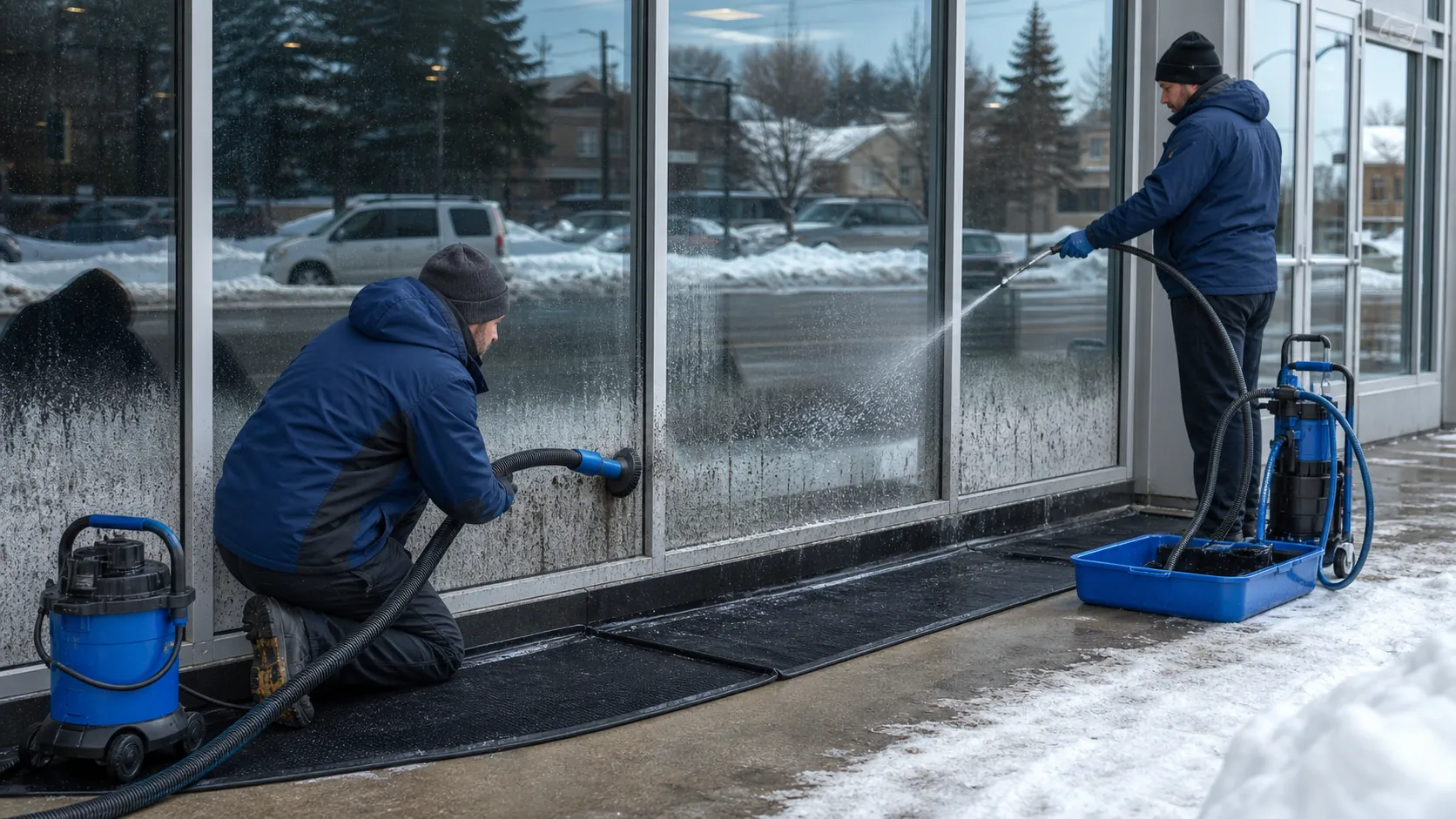
The gray-white band along road-facing windows is rarely just salt. Tires and plows throw deicing material, fine pavement grit, brake and rubber particles, oily road film, soil, and dirty meltwater toward the facade. Water evaporates and leaves soluble crystals around abrasive particles. Repeated wet and dry cycles concentrate the residue at glass edges, frames, gaskets, hardware, and sill pockets.
A quick dry wipe can turn that mix into scratches. A high-pressure rinse can drive it into joints or across pedestrians and frozen pavement. The useful sequence separates solids, soluble residue, oily film, and any damage that remains.
Map the exposure before cleaning
Inspect dry from top to bottom. Note the height of splash, traffic direction, curb distance, parking, snow storage, downspouts, canopies, sprinklers, and snow-removal practices. Compare road-facing panes with sheltered glass. If the same white residue starts above the splash zone, trace masonry, frame, or roof runoff as another source.
Photograph corrosion at fasteners, frame corners, screen frames, hardware, and damaged finish. Salt can accelerate corrosion in susceptible materials, but cleaning cannot replace missing coating or corroded metal. Record cracked seals, blocked drainage, and staining that begins inside the assembly.
Separate what looks white or gray
| Condition | Useful clue | Next decision |
|---|---|---|
| Loose road grit | Distinct particles, gritty track, accumulation on sill | Lift dry or with abundant compatible wetting without rubbing |
| Soluble salt film | White crystals or haze that changes readily with fresh water | Dissolve and remove with enough clean rinse, then dry the assembly |
| Oily traffic film | Gray smear remains after salt dissolves; water behaves unevenly | Use a compatible mild cleaner and clean tools |
| Hard-water or masonry mineral | Repeated spots or runoff path not tied to road splash | Identify source and deposit before using mineral-removal chemistry |
| Corrosion product | Orange, white, green, or gray streak from metal source | Repair the source and test material-specific cleaning |
| Altered glass or coating | Rough, iridescent, dull, or scratched region remains fully dry | Stop ordinary cleaning and assess restoration or replacement |
Road-deicing products differ, and a visual inspection cannot determine their exact chemistry. Do not choose a neutralizer from color. Fresh water and manufacturer-approved routine cleaning are the starting points unless site records identify a specific spill requiring another response.
Identify the window surfaces
Confirm the glass product, exposed coating, applied film, frame finish, gasket, sealant, hardware, screen, and nearby stone or paint. Some low-maintenance exterior glass has a durable but sensitive exposed coating that prohibits blades and abrasives. Painted and anodized aluminum require their own care.
Follow the actual window manufacturer. Andersen, for example, recommends mild soap and fresh water for salt-spray exposure on its named products and warns against pressurized tools in product-care guidance. That does not authorize or prohibit every method on every commercial system; it demonstrates why product identity controls.
Choose a day when rinse water will remain liquid
Evaluate air and surface temperature, wind, sun, shade, drainage, pedestrian route, and the time the facade will remain wet. Water freezing in a sill, on an aluminum threshold, at a door, or across a sidewalk creates equipment and public hazards. Do not add unapproved antifreeze or deicer to window solution.
If the work can proceed, isolate the area and provide runoff collection. Protect snow piles and landscaping from concentrated wash residue where required. A wet vacuum, absorbent mat, or contained low-flow rinse can keep dirty water from refreezing outside the work zone.
Remove dry grit without grinding it
Use a soft clean vacuum attachment or light lifting method compatible with the frame and glass. Keep the nozzle and hard parts from touching the pane. Do not brush a dense sand layer back and forth across glass. Replace or clean the attachment when it loads with grit.
Where dry removal would create dust or the particles are bonded by salt, pre-wet with ample clean water by the approved low-impact method. The objective is flotation and capture, not a thin damp film that turns the grit into abrasive paste.
Dissolve salt with fresh water and complete removal
Work from the upper boundary downward in short sections. Apply enough fresh water to dissolve the soluble layer while controlling where it goes. Use a soft nonabrasive applicator with light agitation, then extract the contaminated liquid. Change water before it becomes a brine bath carried across every pane.
Rinse tools, channels, rubber, and cloths frequently. Salt crystals can lodge at the squeegee end clip or in a towel fold. Do not return a gritty tool to a cleaned section.
Inspect the first dry test. If a gray oily film remains, use a compatible mild cleaning solution on fresh tools, then rinse and extract again. More rubbing is not a substitute for changing contaminated solution.
Clean the assembly, not only the clear area
- Frames: use the finish manufacturer's method and watch for color transfer, chalking, blisters, and corrosion.
- Gaskets and sealants: wipe gently with compatible materials; do not peel, trim, or saturate joints.
- Sills and tracks: vacuum grit first, keep visible drainage paths free, and avoid flooding concealed cavities.
- Hardware: remove salt residue without soaking; inspect for corrosion and lubricate only as the product specifies.
- Screens: clean separately with support and a compatible soft method, then dry before installation.
Salt left at a frame corner can keep attracting moisture after the central glass looks clear. Final drying and inspection matter as much as the rinse.
Know when the residue has become damage
NGA guidance on decorative-glass durability notes that prolonged salt-water contact can contribute to glass-surface corrosion in susceptible conditions. The resulting haze or iridescence is not a soluble film. Coatings and adjacent finishes can also stain, lose gloss, pit, or corrode.
After verified salt, grit, and traffic film are gone, inspect dry in raking light. Fine scratches, rough haze, pits, coating change, and corroded frames need documentation. A glass-restoration test may improve some altered bare-glass surfaces, but it cannot replace a coating or repair corroded metal and failed joints.
Shorten the cycle where deposits concentrate
Waiting until spring gives salt months to cycle between wet and dry. Use condition-based fresh-water maintenance during the season when temperatures and runoff control permit. Road-facing lower bands may need more attention than upper glass.
Manufacturer examples sometimes call for quarterly or more frequent care in salt-rich coastal environments. A winter storefront needs its own measured interval based on product, road treatment, storm frequency, splash height, and how quickly residue returns.
A professional window-cleaning plan should include post-storm inspection, safe-weather criteria, lower-band service, full assembly cleaning, and corrosion referral. The goal is to remove concentrated residue before it becomes a surface or hardware problem.