RO/DI pure-water window cleaning
How sediment filtration, carbon, reverse osmosis, deionization, TDS measurement, brush agitation, final rinsing, reject water, and system care fit together.
Pure water is a process, not a product name
A water-fed pole system can wash and rinse exterior glass while the final water is left to evaporate. That only works when the water reaching the brush has sufficiently low dissolved material and the glass, frame, brush, hose, and technique do not reintroduce contamination.
RO/DI describes reverse osmosis followed by deionization. It is one common treatment train, not the only possible configuration. Source-water quality, pressure, temperature, desired flow, daily volume, membrane design, and resin cost determine whether a job uses DI alone, RO with a final DI stage, or another manufacturer-approved arrangement.
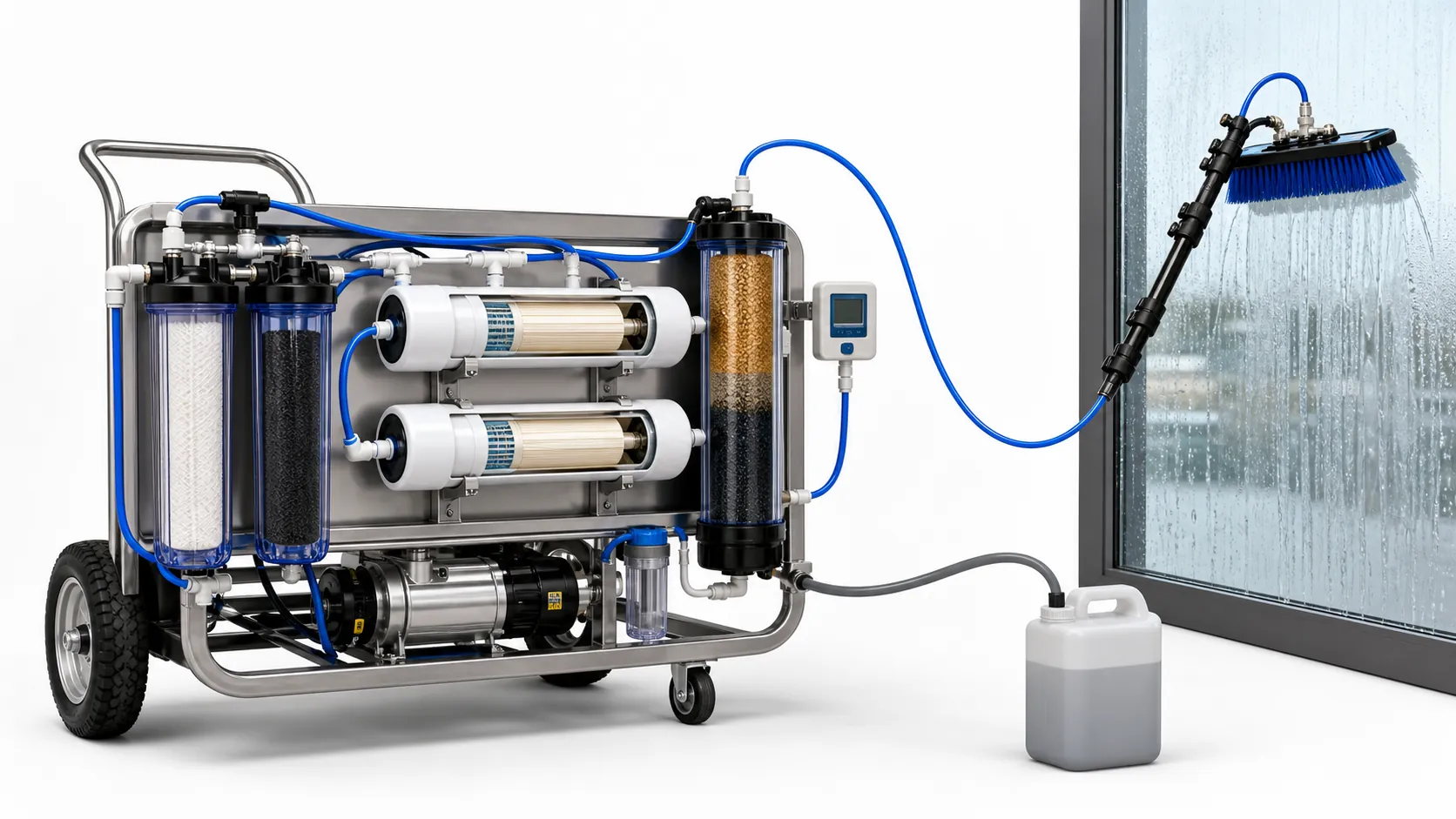
What each stage contributes
| Stage | Primary function | What it does not prove |
|---|---|---|
| Sediment prefilter | Captures particulate material large enough for the selected cartridge rating | Does not remove all dissolved minerals or establish final water quality |
| Carbon or other pretreatment | Reduces specified oxidants or contaminants that can affect downstream membranes, according to the system design | Does not replace the membrane or DI stage |
| Reverse-osmosis membrane | Uses pressure to separate a lower-dissolved-solids permeate stream from a concentrate stream | Does not send all inlet water to the pole and does not reject every substance equally |
| Deionization resin | Exchanges remaining charged ions to polish the product water | Does not remove every neutral organic, particle, or microorganism and has finite capacity |
| TDS or conductivity meter | Provides a repeatable electrical indication related to dissolved ionic material at its measurement point | Does not identify which ions are present or prove sanitary drinking water |
Prefilters protect the membrane
Source water may contain rust, sand, pipe scale, or other particles. The sediment stage reduces that load before water reaches narrower passages. A visibly dirty cartridge, falling pressure, or reduced flow can indicate replacement, but appearance alone is not the service interval. Follow the system's pressure-drop, volume, time, and cartridge instructions.
Many RO systems use carbon pretreatment because chlorine and other oxidants can damage certain membrane materials. Carbon capacity depends on water chemistry, flow, volume, contact time, and the cartridge. Replacing it only after final TDS rises may be too late because membrane exposure can occur before a simple meter reveals the cause.
Do not install a generic filter because it fits the housing. Micron rating, media, capacity, pressure, flow direction, seals, sanitation, and compatibility all belong to the system specification.
Reverse osmosis splits the inlet stream
An RO membrane receives pressurized feed water and produces two outlets. Permeate has a lower concentration of many dissolved materials and continues toward final treatment. Concentrate, sometimes called reject water, carries the separated load away. The concentrate line is a normal part of the process and must not be capped to save water unless the equipment is specifically designed for that operating mode.
Recovery and rejection are different measurements. Recovery describes how much feed becomes permeate. Rejection describes how strongly the membrane reduces a measured dissolved constituent or conductivity. A high recovery setting can increase scale risk and does not automatically mean better filtration.
Feed pressure and temperature affect production. Cold water commonly reduces permeate flow. Low inlet pressure, a blocked prefilter, membrane fouling, scale, damaged seals, or incorrect concentrate control can also change performance. Diagnose using the manual's pressure, flow, and conductivity checks rather than replacing resin first.
DI resin polishes what remains
Mixed-bed deionization resin exchanges positive and negative ions remaining after pretreatment. When RO removes most of the load first, the DI vessel handles less material and can produce more useful water before exhaustion. A DI-only system sends the full ionic load to resin, which may be practical with favorable source water or limited volume but expensive with high TDS.
Exhaustion can show as rising final conductivity or TDS. The replacement threshold belongs to the specific system and work standard. For example, the current UNGER RO60C manual monitors readings before and after resin and gives a model-specific OUT threshold. Do not copy that value to equipment whose meter location, calibration, resin bed, and instructions differ.
Channeling, an incompletely filled vessel, wrong flow direction, exhausted resin, a bypass leak, or poor meter sampling can produce an unexpected reading. Confirm the plumbing and take a stable sample before condemning the media.
What the TDS number means
A handheld or inline meter typically measures conductivity and converts it to an estimated total dissolved solids value using a factor. Two meters can display slightly different ppm values for the same water if their conversion factors, temperature compensation, calibration, or sample conditions differ.
The National Glass Association's 2023 cleaning paper calls for wash and rinse water at 20 ppm TDS or lower when pure-water rinse is allowed to evaporate from architectural glass. A contractor may adopt a lower operational threshold for consistency, but should state the meter, measurement point, and action level.
- Measure the source water to understand the incoming load.
- Measure after RO where the system provides that point to evaluate membrane performance.
- Measure the final product after DI and after enough water has flushed stagnant hose volume.
- Record temperature, pressure, flow, and readings when diagnosing a change.
- Rinse the meter cell and store or calibrate it according to its manual.
A low reading does not certify compatibility with a coating, remove grease, or prove that a dirty brush is clean. It answers one water-quality question.
The brush still performs the cleaning
Purified water does not make bonded contamination disappear. A clean, compatible brush supplies agitation and carries water to the surface. Select bristle material and stiffness for the known glass, frames, gaskets, and finish. A brush used on masonry, oily siding, bird residue, or oxidized frames should not immediately move to sensitive glass.
Clean upper frames before the glass so later runoff does not wash soil across a finished pane. Agitate corners, gasket lines, and the glass systematically without forcing water through vents or failed joints. Organic deposits may need controlled dwell or a separate approved process. Paint, silicone, mineral scale, and scratches require identification rather than more pole pressure.
Rinsing creates the final result
After agitation, lift the brush slightly and rinse with enough clean product water to carry suspended soil off the pane. Work from the upper area downward and keep the final rinse ahead of dirty frame runoff. Do not let a hose drag through soil and then touch the brush stock or glass.
Whether a pane dries clean depends on more than TDS:
- Dirty upper frames or seals can bleed contamination after the rinse.
- Oxidized paint and chalking frames can release material continuously.
- Residual detergent from a previous process can foam or film.
- Hydrophobic coatings and damaged surfaces can change how water sheets.
- Insufficient rinse volume can leave loosened soil on the pane.
- A leaking brush fitting or contaminated pole hose can reintroduce source water.
- Mineral deposits, silicone haze, and scratches remain visible after drying even when the rinse was clean.
Inspect the dry result from normal viewing positions. Do not judge while a continuous water film is hiding fine residue.
Plan the concentrate and hose route
RO concentrate contains the material rejected from the permeate stream. Route it where the property and local requirements allow, away from doorways, public walking paths, landscaping that may be sensitive, and surfaces where concentrated minerals can dry. Do not let it undermine soil or run across a completed facade.
Both product and concentrate hoses create trip hazards. Protect them at entrances, control vehicle crossings, and keep water-fed poles away from overhead electrical conductors. Purified water and a nonmetallic-looking pole do not remove electrical risk.
System maintenance after work
- Flush, preserve, or isolate membranes according to the downtime and storage procedure.
- Do not let membrane elements or resin freeze.
- Keep filter housings, caps, O-rings, and hose ends clean during service.
- Relieve pressure before opening a housing.
- Record source, RO, and final readings along with hours or volume.
- Investigate sudden performance change instead of compensating with an unapproved valve setting.
- Dispose of filters, resin, cleaning solution, and concentrate according to product and local requirements.
RO/DI is useful because it makes water quality measurable and repeatable. A professional pure-water window-cleaning process still depends on correct glass identification, clean brushes, controlled runoff, complete agitation, and a final rinse that is allowed to dry without new contamination.