Water supply for pressure washing: flow tests, inlet losses, filters, and buffer tanks
Measure delivered flow at the machine, account for hose and site losses, protect the pump inlet, and use a buffer tank only as a designed supply system rather than a cure-all.
A strong spigot can still starve the pump
A pressure washer needs a stable supply of clean water at the flow, pressure, and temperature allowed by its manufacturer. The number printed on a building plan or read at an unloaded faucet does not tell you what reaches the pump after a long hose, an elevation change, small fittings, a dirty filter, and other users draw water from the same branch.
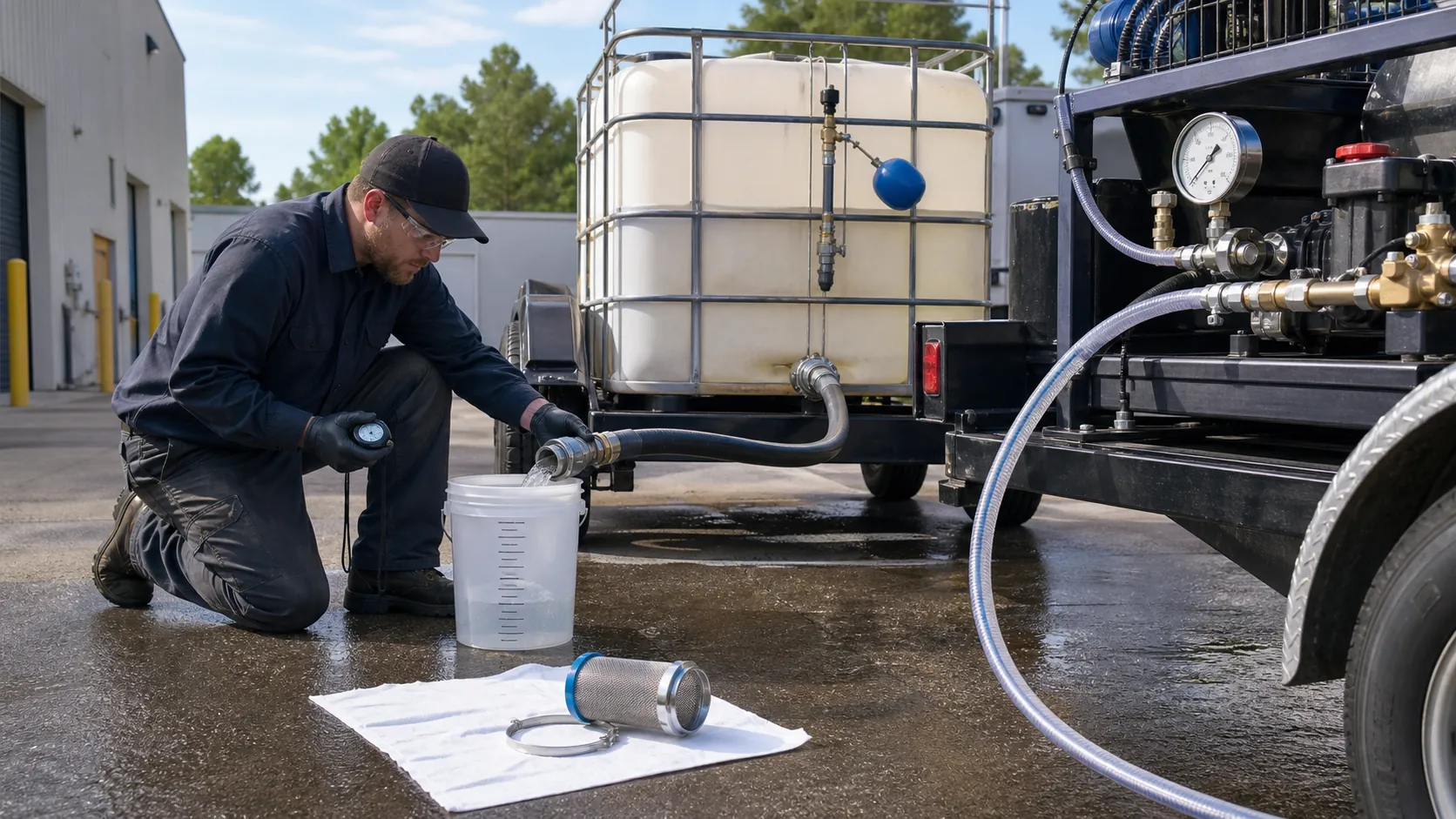
Inlet starvation is expensive. A positive-displacement pump can lose smooth flow, run hot, cavitate, and damage internal components when it cannot fill correctly. More throttle is not a remedy for missing inlet water.
Start with the machine manual
Record the exact pump and pressure-washer model. Find the manufacturer's limits for minimum supply flow and pressure, maximum inlet pressure and temperature, inlet hose arrangement, filter, allowable tank feed, priming, and startup. These values are not interchangeable among machines.
For example, one professional washer manual may specify a particular minimum flow and pressure at the inlet. That number applies to the named machine, not to every washer on a trailer. A direct-drive pump, belt-drive pump, electric unit, hot-water skid, and tank-fed system may have different requirements and plumbing.
Measure delivered flow, not a guess
Build the supply path you plan to use: source valve, approved backflow device where required, hose, reel or fittings, elevation, and inlet filter. Put the discharge end at the machine location. Open the source fully and let trapped air clear. Then time how long it takes to fill a container with a verified volume.
Flow in gallons per minute equals the container volume in gallons divided by fill time in seconds, multiplied by 60. Repeat the test. If a five-gallon container fills in 75 seconds, delivered flow is 4 gallons per minute. The arithmetic is simple; the test conditions are what make the result useful.
- Test during the hours when the job will run.
- Turn on other building demand that is expected to remain active, with site permission.
- Use the full planned hose length and actual fittings.
- Record source pressure and machine-end pressure if the manufacturer requires a pressure value and suitable instruments are available.
- Retest after changing a filter, hose, elevation, valve, or source.
Do not infer adequate inlet flow from the washer's rated output alone. The supply needs enough margin to remain within the machine requirement as demand and pressure vary.
Where inlet capacity disappears
| Restriction or condition | What happens | Useful check |
|---|---|---|
| Long or small-inside-diameter hose | Friction loss rises and machine-end pressure falls | Compare the approved larger or shorter hose under the same source condition |
| Kink, flattened reel layer, or soft collapsing hose | Flow area narrows, sometimes only while the pump draws | Lay out the hose, inspect it unpressurized, and watch for collapse during controlled startup |
| Partly open valve or restrictive quick fitting | A small passage becomes the bottleneck | Trace every valve and fitting, not only the hose label |
| Dirty inlet screen or undersized filter | Pressure drop increases as debris accumulates | Isolate water, service by the manual, and compare clean-filter readings |
| Air leak on a suction section | Bubbles enter even when liquid does not leak outward | Inspect seals, clamps, hose condition, pickup position, and clear sections if provided |
| Elevation gain | Available pressure at the pump decreases | Measure at the actual upper location rather than the ground-floor spigot |
| Shared building branch | Supply varies as fixtures, irrigation, or equipment operate | Repeat the test under realistic simultaneous demand |
A larger hose does not create water that the source cannot deliver. It can reduce avoidable friction loss. Likewise, a high static pressure reading with the valve closed says little about flow pressure after the machine starts drawing.
The inlet filter protects more than the nozzle
Debris entering the pump can damage check valves, seals, and other components. Use the filtration specified for the machine and water source. A fine element placed where it is too small for the required flow can become its own restriction, while a coarse screen may not protect a pump from a dirty tank.
Inspect the source container, pickup, screen, clear bowl, seals, and element with the system isolated. Clean or replace parts by the manufacturer's procedure. Never open a housing under pressure. Record service intervals by observed condition and pressure or flow change, not only by calendar.
What starvation looks and sounds like
Stop the machine if it develops a gravel-like cavitation sound, repeated surging, a collapsing inlet hose, visible air, unstable inlet pressure, unusual pump heat, or output that improves only when the trigger is released. The same symptom can have more than one cause, so work from inlet to outlet rather than adjusting the unloader at random.
- Shut down and relieve stored pressure according to the manual.
- Confirm the source valve and actual delivered flow.
- Inspect the supply hose, fittings, filter, tank level, pickup, and air leaks.
- Confirm nozzle condition and that downstream components are correctly sized.
- Escalate persistent pump or unloader symptoms to qualified service.
A buffer tank solves timing, not scarcity
A correctly designed buffer tank stores water while the source fills it and supplies the pump during short periods when pump demand exceeds incoming flow. It can also separate variable building flow from a stable equipment feed. It does not create daily water volume. If the average source flow remains below average job consumption, the tank eventually empties.
Size is only one design question. The system also needs suitable tank material, secure mounting, controlled fill, overflow, drainage, cleaning access, venting, level indication, low-level shutdown where appropriate, backflow protection, and plumbing that will deliver water without vortices or air. A pump that is not approved for gravity feed may require a booster or different arrangement.
Vehicle payload matters. Water weighs about 8.34 pounds per US gallon before the tank, frame, hose, and equipment are counted. A partially filled, unbaffled tank also creates moving load. Confirm vehicle ratings, tie-down design, local transport rules, and the tank manufacturer's installation requirements.
Commission the whole supply path
Before production work, fill and inspect the system for leaks, flush new plumbing as directed, confirm valves and overflow, prime by the machine procedure, and run a controlled test with the correct nozzle. Record source flow, tank refill rate, operating duration, inlet condition, pump behavior, and the water level at which operation must stop.
A dependable power-washing setup begins before high pressure is made. When the inlet is measured and documented, low output becomes easier to diagnose and the pump is no longer asked to compensate for an undersized hose or an empty tank.