Pressure washing, hot-water power washing, and soft washing
How water temperature, flow, pressure, chemistry, dwell, and surface compatibility change three commonly confused exterior-cleaning methods.
The label does not define the process
Pressure washing and power washing are often used as interchangeable names. Soft washing is sometimes treated as though it means no pressure at all. Those labels are too loose to guide work on a real property. A useful scope states the water temperature, approximate working pressure and flow, chemical, application method, dwell, agitation, rinse method, and materials being cleaned.
Three jobs can use similar hoses and still place very different loads on a surface. Cold water under higher pressure relies heavily on hydraulic impact and flow. A hot-water machine adds heat. Soft washing shifts more of the cleaning work to compatible chemistry and dwell while keeping application and rinse pressure lower.
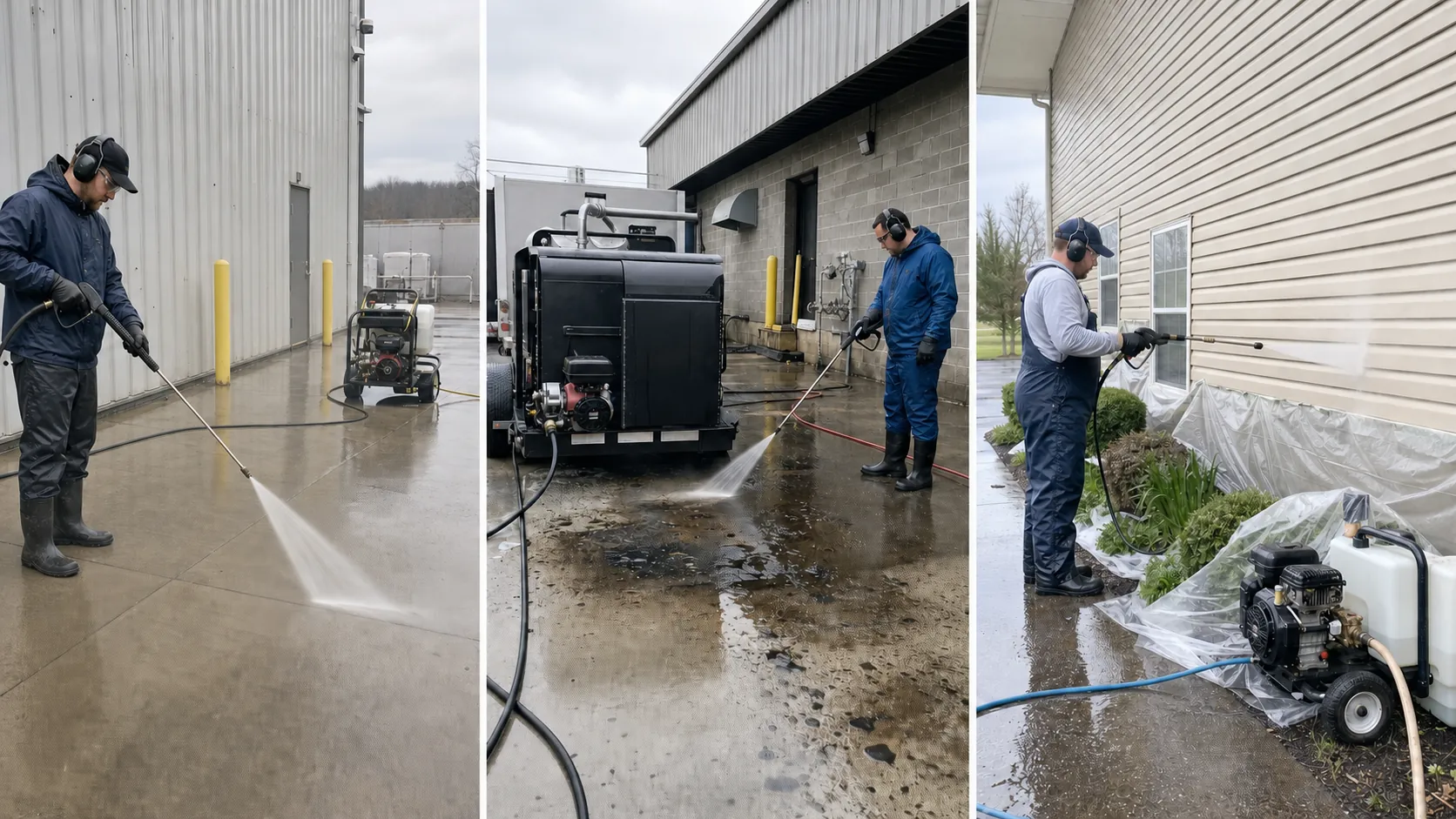
Three methods in practical terms
| Method | Where most of the cleaning action comes from | Common considerations |
|---|---|---|
| Cold-water pressure washing | Water flow, impact, spray geometry, agitation, and sometimes detergent | Useful on many durable exterior surfaces when pressure and distance are controlled; can etch, scar, force water, or strip finishes |
| Hot-water power washing | The same hydraulic factors plus heated water and compatible chemistry when needed | Can improve removal of oil and grease; adds burner, fuel, exhaust, scale, heat, and material-compatibility concerns |
| Soft washing | Surface-specific chemistry, wetting, dwell, limited agitation, and a lower-pressure rinse | Reduces mechanical impact but requires accurate mixing, plant and metal protection, runoff control, and complete rinsing |
No row is a promise of safety. A low-pressure chemical can discolor a metal or plant. A cold-water rinse can still enter a failed joint. Hot water can soften a coating or sealant. The method must fit both the soil and every material the runoff will touch.
Cold-water pressure washing
A pressure-washer pump supplies flow. Restriction at the nozzle creates working pressure within the limits of the machine and its components. The operator changes the concentration of impact through nozzle selection, fan angle, distance, and movement.
Cold-water work is well suited to many routine soil-removal tasks on sound, durable substrates. Loose dirt, mud, and some atmospheric buildup may release through wetting, controlled impact, and enough flow to carry contamination away. A surface cleaner can distribute spray over flat concrete, while a fan nozzle can address edges and vertical sections.
The same stream can cut wood fibers, expose concrete aggregate, drive water behind siding, remove oxidation unevenly, or mark soft brick and mortar. Starting close to the surface with a narrow nozzle is not an efficient test. Begin at a conservative distance and pressure on an inconspicuous representative section, then adjust only as the material response allows.
What hot water changes
A hot-water pressure washer adds a burner and heating coil downstream of the pump on common machine designs. The heated water can improve the removal of oily or greasy soil and may reduce the mechanical effort or chemical concentration needed for a particular task. Commercial kitchen service areas, vehicle residues, and some industrial soils are common reasons to evaluate heat.
Heat does not turn an incompatible process into a safe one. Painted surfaces, asphaltic materials, sealants, plastics, composite products, plant tissue, and some stains can respond poorly to elevated temperature. Hot water can also increase vapor, mobilize grease into runoff, and raise the consequence of hose or gun failure.
The machine itself requires added maintenance. Burner fuel, ignition, airflow, soot, coil scale, exhaust routing, and temperature controls join the pump and engine checks of a cold-water unit. Follow the equipment manual for fuel, descaling, ventilation, and shutdown. Never operate a fuel-burning engine or burner where carbon monoxide can collect or enter an occupied building.
What soft washing changes
Soft washing uses lower application pressure and lets a compatible cleaning solution loosen or alter the target soil during a controlled dwell. The solution may be delivered by a dedicated pump, downstream injector, proportioning system, or another rated applicator. The exact setup matters because it controls concentration, reach, and which equipment components contact the chemical.
This approach is often considered for painted siding, some roof systems, stucco, EIFS, and other assemblies that should not receive concentrated high-pressure impact. Product-specific instructions still govern. Cracks, open laps, failed sealant, vents, electrical penetrations, oxidized finishes, and unknown coatings can make even a low-pressure application unsuitable.
Chemistry does not remove the need for technique. Establish the dilution at the surface, pre-wet or shield compatible plants as required, keep the solution from drying, respect the product's dwell range, prevent incompatible mixing, and rinse the substrate and protected surroundings completely. More dwell or a stronger mix can bleach color, streak oxidation, corrode metals, damage glass coatings, or injure vegetation.
Match the method to both soil and substrate
| Observed condition | Questions before selecting a method |
|---|---|
| Loose soil on sound concrete | Is the slab cured and intact? Are there coatings, weak edges, open joints, or exposed aggregate? Where will the runoff carry sediment? |
| Oil or grease | Is the stain still mobile or already absorbed? Will heat help? Which degreaser is compatible? How will contaminated wash water be contained? |
| Organic growth on siding | What is the siding material and finish? Is oxidation present? Are laps, vents, outlets, windows, and wall penetrations sound? |
| Dark marks on masonry | Are they biological growth, carbon, metal runoff, efflorescence, or damage? Are the brick, mortar, stone, and previous sealer compatible with the proposed chemistry? |
| Roof staining | What does the roofing manufacturer permit? Can the work be done without walking an unsafe surface or sending solution into landscaping and drainage systems? |
A stain is not a material identity. Rust, oil, algae, efflorescence, and coating failure may share a color but require different corrections. Test panels should reproduce the entire proposed process, including pre-wetting, chemical, dwell, agitation, temperature, pressure, rinse, and final dry inspection.
Site control is part of the cleaning method
- Inspect the assembly. Record cracks, loose material, oxidation, damaged joints, open electrical devices, fragile fixtures, and nearby glass or metals.
- Measure the water supply. Confirm that the source can sustain the machine's flow without starving the pump.
- Plan runoff. Identify drains, soil, public paths, neighboring property, and any recovery or disposal requirements before mixing product.
- Protect people and property. Establish an exclusion area, route hoses to reduce trip and vehicle hazards, and keep spray away from occupants.
- Test the full method. Start conservatively on a representative location and allow the area to dry before judging color or uniformity.
- Work in manageable sections. Maintain consistent distance, overlap, dwell, and rinse so that one area does not receive a different process.
- Inspect and document. Record the achieved improvement, remaining stains, surface change, and any maintenance or repair need.
Pressure-washer injuries need respect
The CDC warns that a high-pressure stream can cause serious wounds that look minor at first. Never direct the spray at a person, animal, hand, foot, or another worker's equipment. A suspected injection injury needs prompt medical attention.
Wear protection appropriate to the equipment, chemical, noise, splash, and site. Depressurize the system before changing nozzles or servicing a connection. Use grounded, wet-location-safe electrical protection for electric equipment, and keep gasoline engines outdoors and away from doors, windows, and vents.
Describe the scope instead of selling a label
A clear exterior-cleaning proposal identifies what will be treated, the planned method, the test area, protected items, runoff controls, expected improvement, and conditions excluded from the work. That description is more useful than arguing whether every heated wash should be called power washing or whether every chemical rinse counts as soft washing.