Oil, grease, rust, algae, and efflorescence: why one cleaning method cannot remove every stain
Identify the substrate and stain mechanism, stop the source, use stain-specific chemistry or extraction, control runoff, and judge each dry test rather than increasing pressure across unrelated conditions.
Pressure can move a stain without solving it
A dark patch on concrete may be oil absorbed into pores, wet biological growth, tire rubber, soot, or a shadow from moisture. A white area may be efflorescence, hard-water scale, cleaning residue, or a surface that acid already etched. Orange can be iron oxide, but it can also be soil carried from a corroding source.
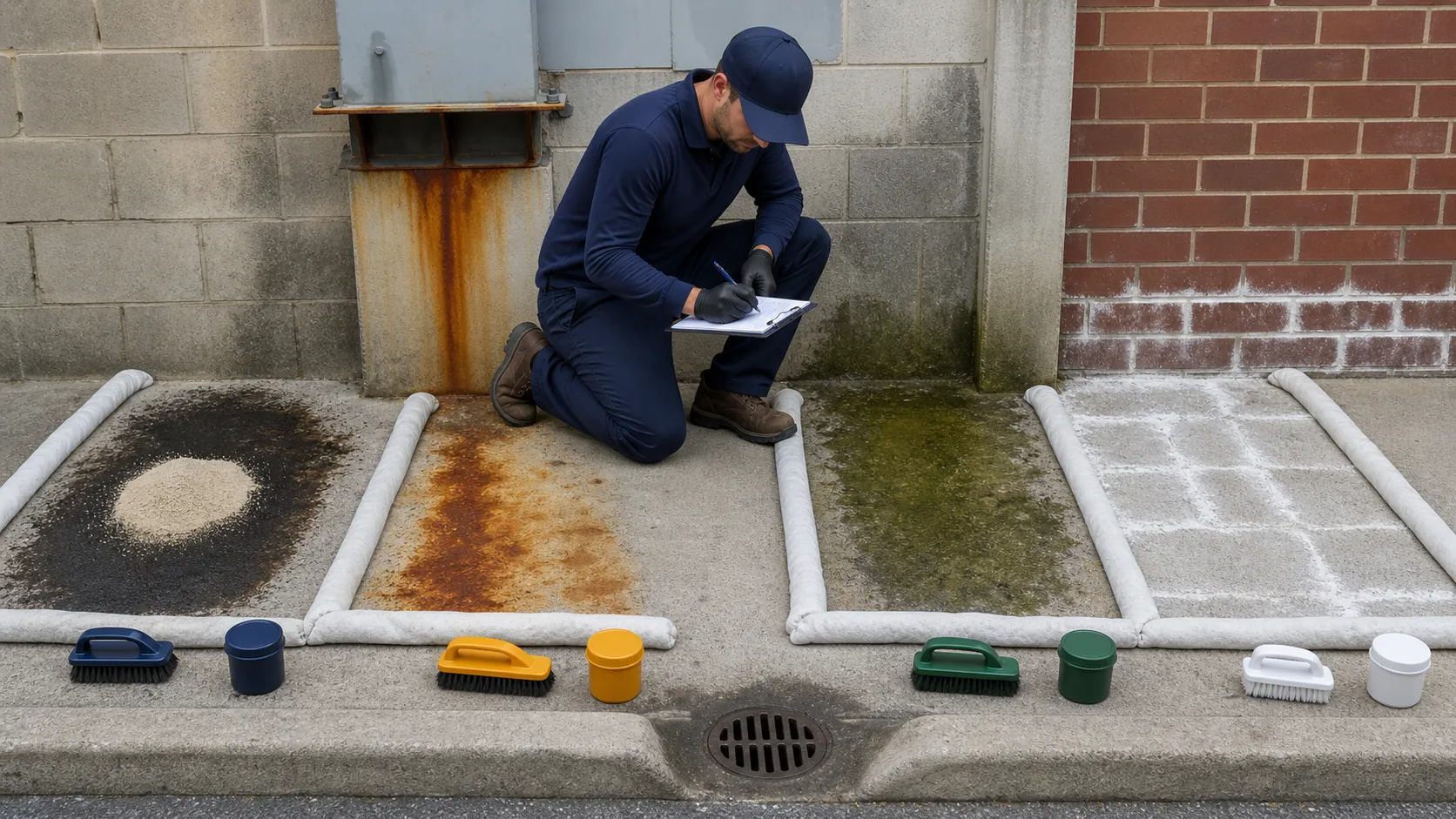
A narrow high-pressure pass may lighten all of them while wet. It may also drive oil outward, spread viable growth, leave rust chemistry untouched, wash off loose salts without correcting moisture, and change the masonry texture. Start with the mechanism.
Identify the substrate before the stain
Determine whether the surface is cast concrete, concrete paver, concrete masonry, clay brick, natural stone, stucco, coated floor, painted wall, asphalt, wood, or composite. Record sealer, coating, color treatment, joints, repairs, porosity, finish, age, and condition.
A cleaner suitable for uncoated concrete may discolor colored pavers, dissolve calcareous stone, soften an acrylic sealer, corrode metal, damage glass, or harm plants. Protect adjacent materials and include them in the test.
Trace the source and age
- For oil, find the vehicle, equipment, food-service area, hydraulic line, or waste container.
- For rust, look above and beside the mark for steel, irrigation, fertilizer, battery equipment, or iron-bearing aggregate.
- For algae or similar growth, map shade, persistent moisture, poor drainage, leaking irrigation, and organic debris.
- For efflorescence, follow water through or across masonry and identify the salt-bearing material.
Fresh contamination is usually easier to contain. A recurring source can defeat an excellent cleaning test within days. Fix leaks, corrosion, drainage, storage, or housekeeping before setting the final appearance expectation.
Oil and grease need removal from the pore structure
Stop and contain a fresh spill before washing. Absorb free material with the site-approved media and collect it for proper disposal. Spraying the spill can enlarge the affected area and send petroleum into a drain or soil.
Once free liquid is removed, use a degreaser, detergent, hot-water process, poultice, or other method approved for the substrate and contaminant. PROSOCO, for example, describes a drying poultice that pulls oil and grease from porous concrete, pavers, brick, and stone. That is one product-specific mechanism, not a homemade formula for every surface.
Work from the outside of a localized spot toward its center when the product method calls for it, so dissolved contamination is not spread into a larger halo. Agitation, temperature, dwell, extraction, and rinse all follow the label. Old penetrated oil may improve without disappearing completely, and several controlled cycles may be preferable to one damaging pass.
Rust treatment is a chemical compatibility problem
Remove or repair the corroding source first. Identify whether the mark is ordinary iron oxide, fertilizer stain, battery-related deposit, metallic transfer, or corrosion from embedded reinforcement. A crack with rust discharge may signal concrete deterioration that cleaning cannot repair.
Rust removers are often acidic or use other chemistry that reacts with iron. The same reaction can etch cement paste, change paver pigment, attack metal, dull stone, or damage coatings. Test the exact product at labeled dilution and contact time. Rinse and neutralize only as its instructions require; do not invent a neutralizing mixture.
Judge color after the area dries. Repeated acid application can create a light patch that becomes more visible than the original stain.
Algae and similar growth involve a regulated product decision
Green, black, or brown growth should be identified well enough to choose a product labeled for the organism and site. In the United States, products making pesticidal claims must be used according to their EPA-approved label. The label controls surfaces, concentration, application, dwell, rinse or no-rinse condition, personal protection, reentry, storage, and environmental restrictions.
Do not assume every dark biological-looking mark is mold, or that household bleach is the correct answer. Mixing bleach with acids, ammonia, or other cleaners can release dangerous gases. Never mix cleaning products.
Physical removal alone may aerosolize or distribute material and may not control regrowth. Correct shade or moisture causes where practical, remove debris, protect plants and waterways according to the label, and use low-pressure application where specified. Pressure is for the approved rinse, not a substitute for product dwell.
Efflorescence is evidence of salt movement
Efflorescence forms when soluble salts travel with moisture and crystallize as water evaporates. On concrete masonry and pavers it often appears as a white powder or haze. It is not the same as algae, paint, or an oil film.
CMHA notes that much efflorescence can first be addressed with dry brushing followed by clean water. More extensive conditions may need a specialized cleaner. Strong acid can alter color and expose aggregate, so a small dry-reviewed test is essential.
Identify rain entry, rising moisture, new masonry curing, failed flashing, irrigation, ponding, or drainage behind the surface. Cleaning the crystals without addressing persistent water movement may only reset the clock.
Compare the four mechanisms
| Condition | Primary objective | Pressure's supporting role | Common failure |
|---|---|---|---|
| Oil and grease | Contain, dissolve or lift, extract from pores | Controlled compatible rinse after treatment | Spreading a larger dark halo or sending oil to drainage |
| Rust | Stop source and chemically reduce the identified stain | Remove loose soil and complete labeled rinse | Etching the substrate or leaving a pale chemical patch |
| Algae or labeled biological growth | Apply the registered product exactly as labeled and correct moisture | Low-pressure application or rinse where the label permits | Aerosolizing material, harming plants, unsafe mixing, rapid return |
| Efflorescence | Remove salts and understand their moisture path | Clean-water flushing after dry or chemical treatment | Washing salts elsewhere or changing masonry color |
Build separate test areas
Do not run four products into one comparison strip. Isolate representative spots with enough unaffected boundary to see halos. Predict drainage with clean water. Protect cracks, joints, metals, glass, paint, landscaping, pedestrians, air intakes, and drains.
- Photograph the dry stain and source.
- Remove loose debris and free contaminant without spreading it.
- Apply one identified product by its label.
- Keep the stated dwell condition and prevent unauthorized drying or runoff.
- Agitate, extract, or rinse by the method.
- Collect wash water and solids as required.
- Let the area dry fully, then compare stain reduction and surface change.
- Record the accepted method before expanding.
Set an honest acceptance boundary
A porous material can retain a shadow after the removable contamination is gone. Old oil may sit below the practical treatment depth. Rust may have altered pigment. Efflorescence can recur until moisture stabilizes. Organic staining may remain after growth is controlled.
Continuing until no color difference remains can scar the substrate. Agree whether the goal is source control, sanitation under a labeled process, maximum safe stain reduction, uniform appearance, coating preparation, or unit replacement.
A professional power-washing plan uses pressure as delivery and rinse energy inside a stain-specific process. It does not ask one nozzle to behave like degreaser, rust chemistry, registered algaecide, and moisture diagnosis at the same time.