Gas versus electric pressure washers
Compare actual flow, working pressure, duty cycle, pump, power supply, water supply, exhaust, noise, mobility, maintenance, and job constraints instead of choosing by fuel alone.
The power source does not define the machine
A compact 120 V electric washer and a cabinet-mounted industrial electric unit belong to the same broad category, but they do not do the same work. Gasoline machines also range from light homeowner equipment to high-flow professional skids. Compare the complete system against the job instead of treating gas or electric as a performance rating.
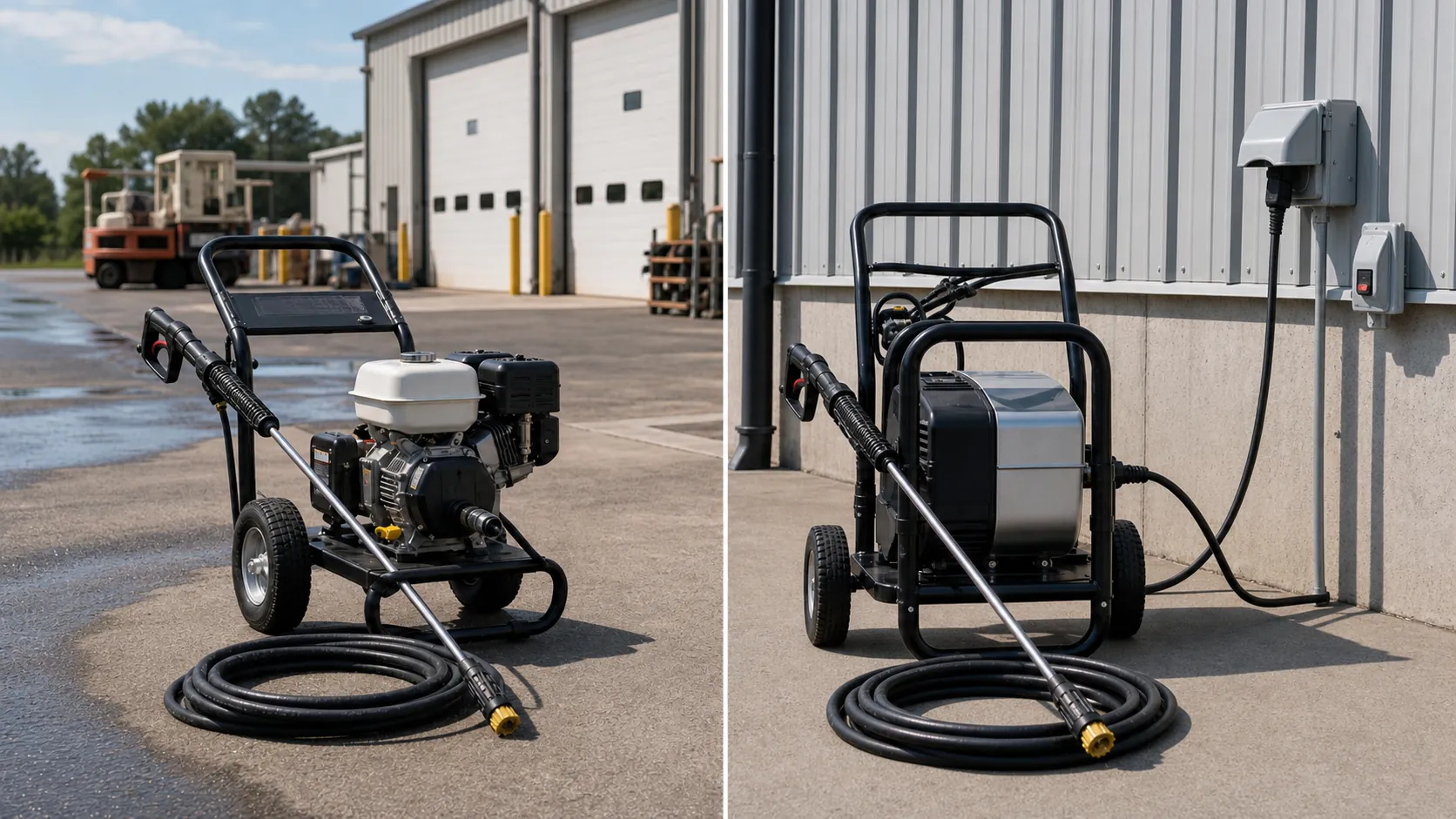
Define the cleaning process first
Identify the surface, contamination, approved chemistry, temperature need, nozzle, desired production rate, runoff plan, access, and acceptable pressure at the substrate. A machine should support that process. Starting with the highest advertised PSI often leads to a poor match.
Record the required flow at working pressure, not only a maximum number on a box. Higher gallons per minute can move loosened soil and feed a surface cleaner more effectively. Pressure provides the force needed at the nozzle, but excess force can etch wood, drive water into a wall, remove coating, scar concrete, or damage seals.
Compare the equipment line by line
| Question | Gasoline unit | Electric unit |
|---|---|---|
| Power availability | Carries fuel but still needs the specified water supply | Needs the specified voltage, phase, amperage, circuit protection, connectors, and water supply |
| Exhaust | Produces carbon monoxide and combustion exhaust; outdoor open-air placement is mandatory | No engine exhaust at the unit, but the source of building or generator power still matters |
| Noise | Engine and pump noise usually affect occupants, operators, and work hours | Often quieter at the point of use, though pump, motor, nozzle, and surface noise remain |
| Mobility | Not tied to a branch circuit, but fuel, heat, weight, and exhaust clearance travel with it | Cable and supply location affect range; fixed high-output units may use long hose runs |
| Maintenance | Engine oil, fuel system, air filter, spark plug, storage, and pump service | Cable, plug, motor, controls, electrical protection, and pump service |
| Typical mistake | Running in an enclosed area or ignoring engine service | Using an inadequate circuit, unsafe extension cord, or wet connection |
Electric does not mean low output
Consumer electric machines are often limited by an ordinary branch circuit. That is a power-supply limit, not a rule about electric motors. Kärcher, for example, lists an industrial 460 V electric cabinet machine rated at 5.6 GPM and 2,500 PSI. Other commercial units use different voltages, phases, and outputs.
Read the nameplate and manual. Confirm voltage, phase, full-load current, dedicated-circuit requirements, conductor size, disconnect, grounding, GFCI or other required protection, plug and receptacle type, and any extension-cord prohibition. A connector placed in a puddle does not become safe because the machine is intended for cleaning.
Gasoline offers independence with a hard ventilation boundary
A gasoline engine can work where suitable electrical power is unavailable. It also creates carbon monoxide, hot exhaust, ignition sources, fuel-handling needs, and more engine maintenance. Never operate one indoors, in a garage, under plastic containment, in a loading bay, or near an opening where exhaust can enter. An open door or a fan is not a substitute for outdoor placement and the manufacturer's clearance requirements.
Position the unit where the operator can inspect it and where heat cannot contact dry vegetation, plastic, stored material, or hoses. Refuel only under the manual's shutdown and cooling procedure. Deal with spilled fuel before restart.
The pump and drive matter on both
Identify axial-cam, triplex, or other pump construction, rated speed, oil requirements, inlet limits, bypass arrangement, thermal protection, service parts, and expected duty. Some machines are designed for intermittent household use. Others are built for longer professional cycles. An electric motor does not make a light pump continuous-duty, and a gasoline engine does not turn every pump into a rebuildable commercial unit.
Check whether the advertised pressure is maximum, rated, or actual at the selected flow. Match the nozzle to pump output. An undersized orifice can overload the system; an oversized or worn nozzle reduces pressure and changes injector and unloader behavior.
Prove the water supply
Time the source flow into a measured container and compare it with the manufacturer's inlet requirement. Inspect hose diameter, length, kinks, filter, tank, float valve, and elevation. A high-output machine starved by a small hose can cavitate, surge, lose pressure, and damage the pump regardless of its power source.
For a buffer tank, confirm the machine is designed and plumbed for the inlet arrangement. Do not assume every direct-drive consumer pump can draw reliably from an unpressurized tank.
Choose around the site
- A noise-sensitive courtyard with suitable power may favor electric equipment.
- A remote exterior with no adequate electrical service may favor gasoline.
- An indoor wash area requires exhaust-free equipment and an electrical installation approved for the wet process.
- A large surface-cleaner route may depend more on sustained GPM, water recovery, and hose layout than fuel.
- A mobile crew may value field service, common parts, secure fuel transport, cable management, or existing fleet compatibility.
These are starting conditions, not automatic answers. Price the electrical work, hoses, tanks, recovery equipment, maintenance, fuel, downtime, and transport needed for the complete setup.
Run an acceptance test before purchase or deployment
- Verify the nameplate and manual against available power and water.
- Install the correct hose, gun, nozzle, filters, and protective devices.
- Measure working pressure and confirm stable flow under the intended load.
- Check leaks, bypass behavior, cable or exhaust placement, noise, and surface result.
- Run long enough to represent the planned duty, then inspect temperature and service conditions.
A professional power-washing system is selected from the substrate outward. Gasoline and electricity solve different site constraints, but neither rescues a mismatched pump, water supply, nozzle, or process.