The complete squeegee workflow
A pane-by-pane method for controlling solution, wetting the glass, setting a dry edge, choosing straight pulls or fanning, and correcting lines.
The squeegee pass begins before the rubber touches glass
Squeegee technique is liquid control. The washer loosens soil and suspends it in solution; the rubber then moves that solution off the pane along a planned path. A clean result depends on wet glass, a sound rubber edge, useful overlap, and a place for the water to go.
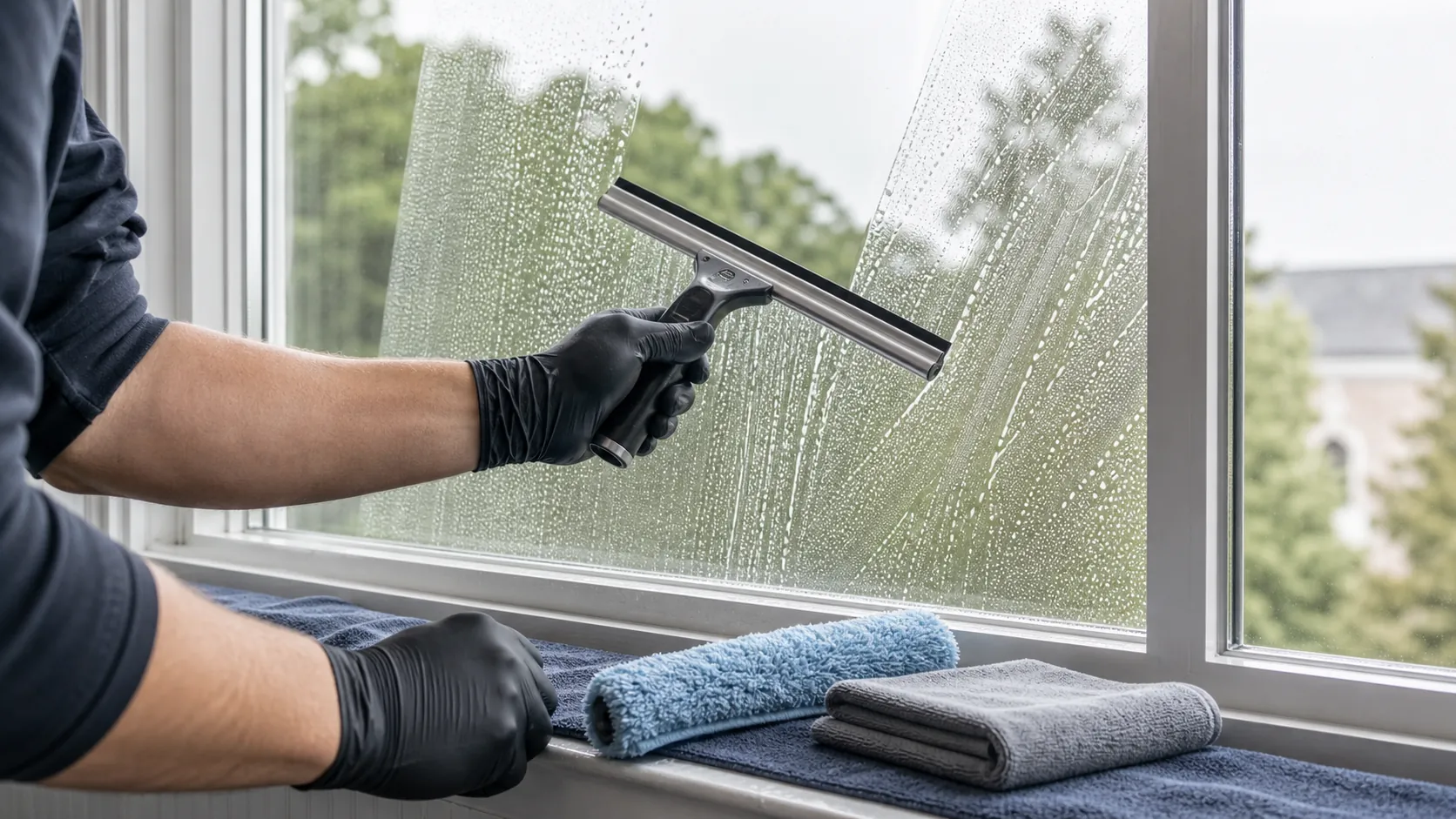
Prepare the pane and the route
- Inspect the surface. Note coatings, film, scratches, chips, bonded debris, failed seals, and fragile frame conditions before cleaning.
- Protect the surroundings. Cover vulnerable floors and sills. Keep solution away from open electrical components, unfinished wood, and materials that cannot tolerate runoff.
- Check the rubber. Clean the edge and look for nicks, hardened corners, waviness, or a bent channel.
- Choose the exit. Decide where each pass will finish and where the tool can be wiped without dripping across completed work.
Glass temperature matters. In direct sun, a large pane can dry before the sequence is complete. Work in smaller sections, reduce dwell time, or change the schedule rather than trying to rescue a half-dry pass with more pressure.
Wet the entire working area
Apply enough permitted solution to loosen the soil and keep the rubber moving over a continuous wet film. Reach the corners without flooding gaskets, tracks, or interior finishes. Work dried residue until it releases safely. If a deposit remains bonded, stop and identify it instead of grinding it with the washer.
Before placing the squeegee, create a narrow clean starting edge with a controlled first pass or a clean towel corner. This cut-in gives the leading end of the rubber a dry boundary and reduces water that can escape around the channel.
Straight pulls
Straight pulls are easy to inspect and work well on narrow panes, divided sections, and pole work. Start at the top. Keep both rubber corners in contact and pull with steady, light pressure. Overlap the previous path enough to collect its wet edge. Wipe the rubber before the next pass when contamination or excess solution gathers on it.
For horizontal pulls, angle the channel slightly so the water moves toward the unfinished area. Finish the lower edge without forcing collected water into the sill. For vertical pulls, control the bead that develops along one side and collect it on the overlapping pass.
Fanning
Fanning keeps the squeegee on the glass while the handle changes direction through connected turns. It can be efficient on open panes, but only when the leading edge stays ahead of the water and the channel maintains contact. The movement should be smooth enough that no dry section catches the rubber.
Use smaller turns near frames. A broad, fast swing can send solution onto a wall or lift a channel corner. Fanning is not automatically more professional than straight pulls. Pane shape, access, and operator control decide which method is appropriate.
Detail only what remains
Use a clean, dry section of towel on the thin perimeter bead and isolated drips. Avoid wiping the center of the pane. If broad areas need towel work, the wetting or squeegee sequence needs correction.
| Visible problem | Likely checks |
|---|---|
| A thin line repeats on every pass | Clean the rubber and inspect for a nick or embedded grain |
| Water trails from one channel end | Check overlap, channel angle, corner contact, and the dry starting edge |
| The rubber skips or chatters | Check for dry glass, excessive pressure, hardened rubber, or an awkward handle angle |
| Uniform haze appears after drying | Review solution concentration, contaminated water, towels, and remaining surface film |
| Random marks remain unchanged | Inspect for scratches, coating damage, mineral deposits, or contamination that routine cleaning cannot remove |
Reset before the next pane
Clean the rubber, rotate to a dry towel section, and check that the washer has not picked up grit. Empty or replace solution that has become visibly contaminated. These few seconds prevent a mistake from repeating across the building.
If a clean, controlled pass leaves mineral haze, scratches, or surface damage, document the condition. Repeated squeegee work will not turn a restoration problem into routine dirt.