
Stucco and EIFS: pressure limits, cracks, penetrations, and water-intrusion risk
Identify the wall assembly, repair openings and impact damage before wet work, follow its manufacturer, and use a contained low-force test that does not drive water through joints, penetrations, or thin finish layers.
A textured wall does not reveal what supports it
Traditional cement stucco, one-coat stucco, exterior insulation and finish systems, direct-applied finishes, acrylic coatings, and repaired patches can share a similar texture. Beneath that finish may be masonry, sheathing, foam insulation, drainage components, mesh, lath, weather barrier, or an occupied interior. A cleaning method based only on color and texture can force water into the assembly.
Identify the wall from records and details
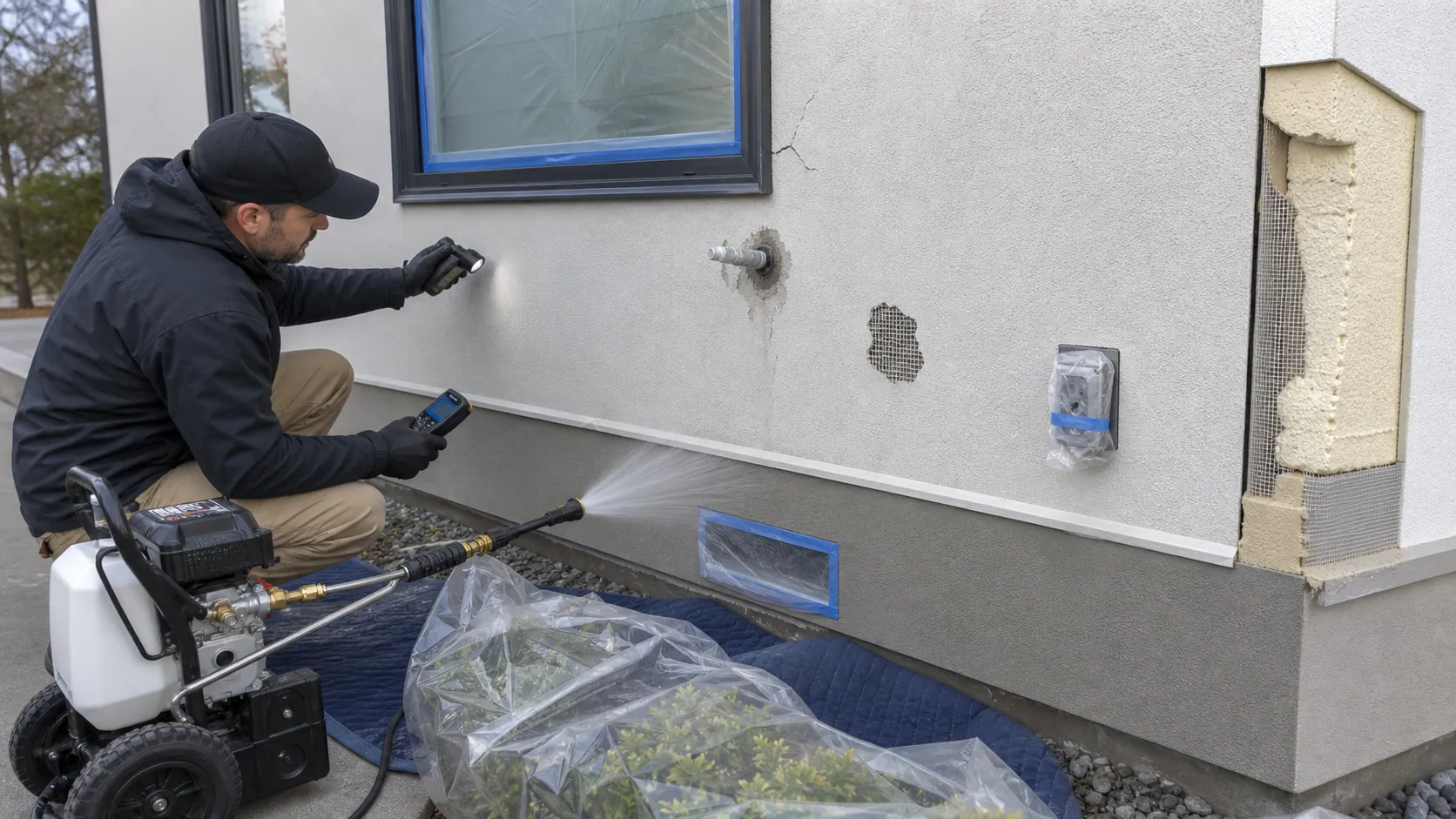
Review drawings, submittals, warranties, manufacturer, installer, repair history, coating records, and moisture investigations. Examine terminations at grade, roof, parapet, window, door, expansion joint, vent, pipe, light, sign, railing, and dissimilar material.
EIFS often has a thin reinforced base coat over insulation with a textured finish. Traditional stucco is a cementitious plaster assembly with different mass, cracking, absorption, and repair practice. Tapping, probing, or cutting an unknown wall can damage it; use a qualified envelope professional when records and visual details are inconclusive.
Map water-entry paths before applying cleaner
- cracks at window corners, control joints, parapets, and changes in substrate;
- open, split, hardened, missing, or poorly bonded sealant;
- impact dents, exposed mesh, punctures, delamination, blistering, and loose finish;
- unsealed fasteners, pipes, conduit, signs, lights, vents, outlets, and railing anchors;
- failed flashing, clogged drainage, low terminations, roof leaks, and landscape irrigation;
- interior stains, odor, soft sheathing, elevated moisture, or prior mold response.
Cleaning does not close these openings. Repair with the wall-system manufacturer's compatible details, allow materials to cure and dry, and resolve the water source before broad wet work. If interior symptoms or concealed damage are suspected, cleaning should wait for envelope assessment.
Classify the surface condition
| Condition | Question before cleaning |
|---|---|
| Loose dust and atmospheric soil | Can a gentle rinse and soft brush remove it without changing texture? |
| Algae, mildew, or biological film | What moisture source supports it and what labeled product is approved? |
| Rust or metal runoff | Which fitting is corroding and is the finish compatible with a stain treatment? |
| Efflorescence or mineral | Is moisture moving through or over the wall, and is the finish cementitious or acrylic? |
| Chalking, fading, or worn coating | Will cleaning expose a permanent finish difference that requires recoating? |
| Impact damage or exposed reinforcement | What repair system restores the lamina before water is introduced? |
Do not use stronger pressure to make oxidized coating or faded pigment match a protected area. That removes more finish without restoring its original appearance.
Use the actual manufacturer as the pressure authority
There is no universal safe pressure for all stucco and EIFS. Dryvit publishes one product-specific example using a low-pressure washer below 500 psi, a fan tip, and a minimum twelve-inch distance. Those numbers illustrate how conservative an EIFS procedure may be; they are not permission for every brand, age, repair, crack, or texture.
Obtain current care instructions for the installed system. Confirm cleaner, dilution, application pressure, rinse pressure, nozzle, angle, distance, temperature, dwell, brush, and prohibited chemicals. Some assemblies may call for garden-hose flow and hand agitation rather than pressure-washer output.
Build a contained test on a sound area
- Choose representative soil and finish away from open joints or damage, while still matching exposure.
- Protect windows, doors, metal, roofing, outlets, intakes, plants, paving, and occupants.
- Test drainage with clean low-flow water. Watch both the exterior and accessible interior.
- Apply the least aggressive approved cleaner without atomizing it into openings.
- Keep within the stated dwell and prevent drying.
- Agitate gently with the specified soft brush where needed.
- Rinse with broad low-force flow directed down and across the sound face, never upward into laps or joints.
- Capture discharge as required, let the wall dry, and inspect texture, color, coating, sealant, and interior.
Make the sample large enough to show transitions. A tiny bright dot can look worse than the original soil and cannot demonstrate uniform production technique.
Control angle, distance, and time
Impact depends on more than the machine gauge. Nozzle orifice, fan, flow, distance, angle, operator speed, and dwell at one point change the force on the wall. Maintain the validated setup and keep the fan moving. Never use a zero-degree or rotating impact nozzle on an EIFS finish.
Reduce water around windows, sealants, electrical boxes, terminations, and repaired areas. Do not aim upward beneath horizontal edges or sideways into open joints. Avoid leaning ladders, hoses, or surface-cleaning equipment against the finish.
If the wall absorbs rapidly, darkens behind a crack, produces bubbles, sheds aggregate, exposes mesh, dents, softens, or leaks inside, stop. More distance is not an adequate response to an opened pathway.
Manage chemistry and runoff
Review label and safety data sheet. Test metals, glass coatings, sealants, paints, roofing, pavers, and vegetation that can receive mist or runoff. Do not mix products. Keep cleaner from drying, concentrating at the base, or entering a wall cavity.
Plan public exclusion, drain protection, collection, disposal, and plant care under local requirements. Low pressure does not make a chemical harmless, and a biodegradable claim does not authorize discharge.
Inspect after drying and after weather
Dry color and texture determine visual acceptance. Inspect for bright spots, lap marks, exposed aggregate, coating loss, softened sealant, reopened cracks, and residue. Check the accessible interior and moisture observations recorded before work.
For a sensitive or previously leaking building, schedule a follow-up after rain or the next environmental cycle. Cleaning may reveal an existing leak that was hidden by dirt. The record should separate pre-existing envelope findings, repairs, test conditions, cleaned areas, and anything referred for further investigation.