
Brick and mortar cleaning: saturation, chemistry, test panels, and rinse control
Identify the masonry and stain, obtain manufacturer-supported chemistry, build a representative dry test panel, control absorption and rinse, and stop before pressure or acid alters the wall.
Brick is a family of products, not one pressure setting
A red extruded face brick, soft historic common brick, glazed unit, sand-molded brick, concrete brick, clay paver, repointed wall, and thin adhered veneer do not respond alike. Mortar can also vary by age, strength, pigment, profile, and cure. Choosing a nozzle before identifying the wall puts force ahead of evidence.
The stain matters just as much. Fresh mortar smear, aged carbon, algae, rust, efflorescence, paint, oil, hard-water runoff, and an old acid burn require different decisions. Some conditions are deposits; others are changes to the masonry itself.
Build a wall record before the sample
- identify brick manufacturer, product, color blend, texture, coatings, water repellents, and cleaning bulletin;
- record mortar type, pigment, age, cure, pointing profile, patches, cracks, open joints, and sealant interfaces;
- map porous units, glazed faces, cast stone, limestone, metal, glass, painted trim, wood, electrical work, plants, and grade conditions;
- trace the stain source, including roof runoff, irrigation, flashing, corroding metal, construction practice, biological moisture, and prior cleaner;
- inspect inside for leakage, staining, or vulnerable finishes before adding water outside.
Keep pallet tags, submittals, leftover units, and product literature. PROSOCO and brick manufacturers can make project-specific cleaner recommendations from the actual masonry rather than its color alone.
Separate common conditions
| Condition | What to confirm | Why the distinction matters |
|---|---|---|
| New mortar smear | Mortar age, cure, brick absorption, manufacturer cleaning window | Cleaning too early damages joints; too late may require a different process |
| Efflorescence | Loose salts, moisture path, source salts, recurring wetting | Surface removal without moisture correction can be temporary |
| Biological growth | Moisture, shade, substrate, label-approved treatment | Killing and removal are not achieved reliably by pressure alone |
| Rust or metal runoff | Corroding source and masonry sensitivity | General masonry cleaner may not remove iron and can set another stain |
| Paint or coating | Coating chemistry, age, vapor role, historic significance | Removal can damage the fired face or trap solvent and residue |
| Acid burn or altered face | Color and texture remain changed after neutral dry cleaning | More acid cannot clean material that was chemically altered |
Design a representative test panel
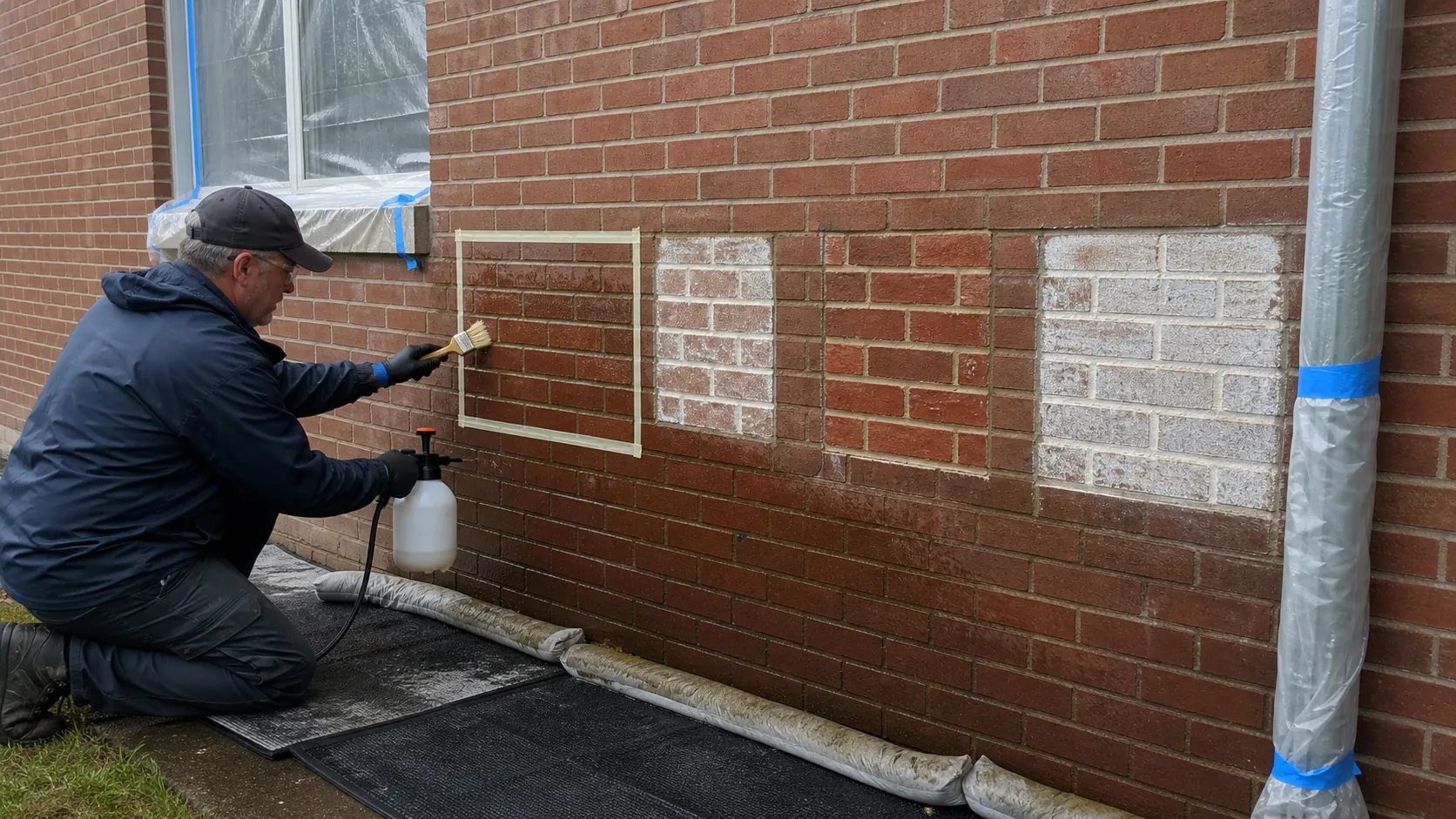
Select a location that contains typical brick, mortar, stain density, orientation, shade, and adjacent material. A hidden panel is useful for safety but may not represent a sun-baked south wall. Include both the heaviest realistic stain and an ordinary area.
Write the test recipe before work: product, lot, dilution, water source, surface and air temperature, prewet procedure, application tool, coverage, agitation, dwell, rinse equipment, distance, direction, passes, capture, and weather. Follow the brick and cleaner manufacturers when they require a different process.
Test the least aggressive supported option first. Do not improvise by adding muriatic acid, mixing cleaners, increasing concentration beyond the label, or letting a weak trial dry on the wall. A failed mild test is information, not permission to jump to an uncontrolled method.
Saturation controls where the cleaner goes
For many new-masonry cleaning systems, thorough prewetting fills near-surface pores with clean water so the cleaner works at the face instead of being drawn deeply into brick and mortar. Acme Brick and PROSOCO emphasize working in manageable sections, keeping the area wet as directed, and preventing cleaner or dissolved mortar from drying or being pulled into dry masonry below.
Prewetting is not a universal instruction for every coating, stain remover, freeze condition, or historic assembly. Some products call for a dry surface. Follow the selected system. Also confirm that the wall can drain and that interior materials will not be damaged by the planned volume.
Control application, dwell, and agitation
- Protect glass, aluminum, painted surfaces, vegetation, people, drains, and lower masonry.
- Apply the approved dilution uniformly with equipment compatible with the product.
- Work only an area that can be completed before the cleaner dries.
- Maintain the specified dwell. Reapply or mist only if the instructions permit it.
- Use a masonry-safe brush or controlled mechanical action where approved. Avoid metallic brushes that can abrade the face or leave particles.
- Observe brick and mortar separately. Bubbling, rapid color change, softened joint, exposed sand, or etched face is a stop signal.
Temperature changes reaction rate and drying. A warm-weather panel does not automatically validate a cold-weather production day. PROSOCO recommends retesting when conditions materially change and warns against cleaning saturated masonry in freezing conditions.
Rinse the reaction out of the wall
A rinse must carry cleaner and dissolved soil away without driving them deeper, cutting mortar, or flooding openings. Use the flow, pressure, fan, distance, and sequence specified for the system. Prewet or rinse lower masonry as directed so runoff does not create streaks.
Do not point a narrow jet into mortar joints, weeps, window perimeters, vents, or cracks. Pressure can remove loose matter quickly while permanently changing the texture that made the brick face look uniform. High pressure also creates an aerosol and expands the containment area.
Plan where the liquid goes. Review local discharge requirements, cleaner label, pH or treatment obligations, sediment capture, drain protection, plant protection, and public access. A clean test square above an uncontrolled stain plume is not an accepted method.
Wait for the panel to dry
Wet brick is darker and can hide lightened faces, acid burn, remaining mortar, and uneven absorption. Allow the full panel, joints, and transitions to dry under representative conditions. PROSOCO examples call for an extended dry review rather than immediate wet approval.
Inspect color blend, texture, joint profile, aggregate exposure, streaks, salts, glaze, adjacent metal, and the boundary around the test. Compare from the normal viewing distance, then close up. Photograph with a color reference and repeatable light.
Owner, mason, brick supplier, cleaner representative, and cleaning contractor should approve the same panel in writing. Mark it for production comparison. If the proposed cleaning cannot remove the stain without altering the accepted masonry, revise expectations, repair selected areas, or leave the condition rather than intensifying blindly.
Production should copy the panel, not reinterpret it
Train the crew with the approved recipe and a visible control. Check dilution, equipment wear, application rate, dwell, weather, wall temperature, and rinse continuously. Break elevations into sections that match access and drainage. Record any product or condition change and pause for another test.
After completion, correct leaking flashings, irrigation, corroding metals, open joints, or other stain sources. Cleaning can reveal defects, but it cannot repoint failed mortar, rebuild flashing, restore a burned brick face, or make a wet wall sound.