Axial-cam versus triplex pressure-washer pumps
A purchase and maintenance comparison based on pump layout, workload, speed, lubrication, service parts, water supply, and the complete machine around the pump.
The pump label does not determine the whole machine
Axial-cam and triplex describe two pump layouts used on pressure washers. The words do not establish build quality, useful life, pressure, flow, service support, or whether a machine fits a particular workload. A well-supported axial pump used within its design can be a better purchase than a poorly matched triplex unit with no parts path.
Compare the complete system: engine or motor power, pump speed, rated flow and pressure, unloader design, inlet conditions, hose and gun ratings, frame, access to service points, manuals, warranty, and local parts availability.
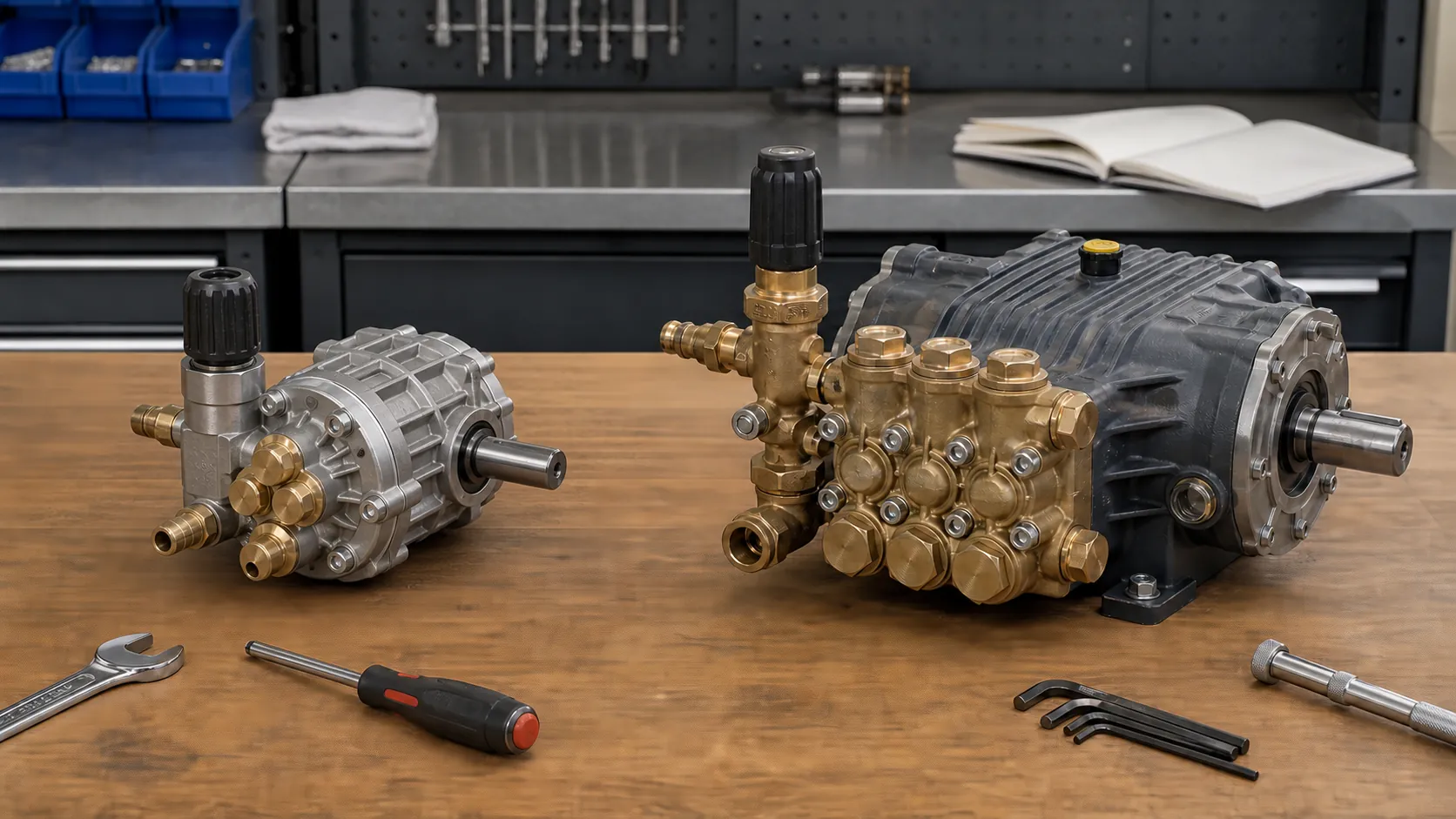
How the two layouts move water
Axial-cam pump
In a common axial-cam design, pistons are arranged around and generally parallel to the drive axis. An angled cam or wobble mechanism produces the reciprocating motion as the shaft rotates. The layout can connect compactly to an engine or motor and is common on portable consumer and light-duty machines.
Axial pumps vary. Some are sealed and described by the manufacturer as maintenance free. Others have service procedures or replaceable assemblies. The exact model manual decides whether oil can be checked or changed, which valves and seals are available, and whether the manufacturer expects repair or pump replacement.
Triplex plunger pump
A triplex pump uses three plungers driven through a crankshaft and connecting-rod mechanism. Its crankcase lubrication is separated from the water end on common serviceable designs. Valves, packing, seals, plungers, bearings, and oil can often be inspected or replaced according to the model's service documentation.
This layout is widely used for sustained professional work because manufacturers offer pumps across many flow, pressure, speed, and duty ranges. The word triplex still does not promise commercial durability. Materials, crankcase size, operating speed, power match, lubrication, unloader setup, inlet plumbing, and service support remain decisive.
What tends to differ in ownership
| Decision factor | Axial-cam tendency | Triplex tendency |
|---|---|---|
| Purchase and packaging | Often lower cost, compact, and light on portable machines | Often larger, heavier, and more expensive for a comparable output class |
| Service approach | Some models are sealed or replaced as an assembly; verify parts before purchase | Many models are designed for seal, valve, plunger, bearing, and oil service |
| Workload | Common for intermittent residential or light-duty use | Common for repeated or longer-duration professional use when correctly sized |
| Lubrication | May be factory sealed or model-specific | Often has a serviceable oil-filled crankcase with inspection and change intervals |
| System options | Frequently sold as a fixed engine-pump package | Available in many direct-drive, gear-drive, and belt-drive configurations |
These are purchasing tendencies, not engineering guarantees. Read the data sheet and manual for the exact pump. Do not infer an oil procedure or duty rating from the housing shape.
Direct drive and belt drive are a separate comparison
Pump layout does not state how the pump connects to the engine. A triplex pump can be direct coupled, belt driven, or gear reduced. Many portable axial pumps are direct mounted, but that does not make axial and direct drive synonyms.
Direct drive produces a compact package and typically turns the pump near engine speed when coupled one-to-one. Belt or gear systems can place the pump away from engine heat and select a different pump speed, but they add alignment, guards, belts or gears, frame size, and maintenance. Choose the drive around the rated pump speed and machine design, not around a slogan that one arrangement always lasts longer.
Match flow, pressure, speed, and power
The pump data sheet defines rated speed, flow, pressure, inlet requirements, oil, and power demand. The engine or motor must supply enough power at the intended operating point. A pump advertised for a high maximum pressure will not produce that pressure and full flow when paired with an undersized drive.
The nozzle must also match the pump flow and intended pressure. Too small an orifice can overload the system or keep excess flow in bypass. Too large an orifice reduces working pressure. The unloader must be sized and set by its procedure, not used to disguise a mismatched engine, pump, or nozzle.
Water supply can destroy either design
No pressure pump works well without a clean, adequate inlet. A restricted supply hose, clogged filter, air leak, undersized tank outlet, excessive inlet temperature, or poor gravity feed can cause cavitation and erratic operation. Repeated inlet starvation damages axial and triplex pumps alike.
Check the manual for minimum inlet flow, allowable pressure, temperature, hose diameter, filtration, and tank-feed arrangement. Purge air as directed before starting. Never let the pump run dry, and avoid leaving a system circulating in bypass longer than the manufacturer permits because recirculated water heats quickly.
Maintenance follows the exact model
For an axial-cam machine
- Follow the manufacturer's engine, inlet-screen, nozzle, hose, and pump-storage instructions.
- Do not open a sealed pump or add oil merely because another axial model allows it.
- Confirm whether valves, seals, a thermal-relief valve, unloader, or complete pump are available before the warranty ends.
- Protect the pump from freezing and use the specified storage procedure.
For a serviceable triplex machine
- Check oil level and condition at the stated interval with the pump positioned as instructed.
- Use the specified oil and change schedule; overfilling and the wrong lubricant can cause problems.
- Inspect for water or metal contamination in oil, oil leakage, water-end leakage, pulsation, and abnormal noise.
- Follow torque, seal orientation, valve order, cleanliness, and break-in instructions during service.
A milky crankcase can indicate water contamination, while oil at the water end or persistent leakage can indicate failed seals. Stop and diagnose rather than continuing until a repairable pump becomes a larger failure.
Questions to ask before buying
- How many hours at a time and how many days per week will the machine run?
- What measured flow and pressure does the work require, not merely the largest advertised number?
- Does the exact pump have a manual, parts diagram, service kits, and a supplier who can identify parts by model and serial number?
- Can the available water source feed the pump under the intended hose and tank arrangement?
- Are the engine, pump, unloader, hose, gun, accessories, and nozzle matched at the planned operating point?
- Can routine inspection points be reached without dismantling the frame?
- What is the cost and downtime for a pump replacement compared with planned seal or valve service?
For occasional home use, compact packaging and simple storage may matter more than rebuilding a crankcase years later. For a crew whose revenue depends on daily washing, service parts, spare-pump strategy, duty rating, and supplier support can outweigh the lower purchase price.
How to assess a used machine
Identify the engine, pump, and unloader by actual model numbers. Check the manuals before running it. Inspect oil where serviceable, water and oil leaks, corrosion, freeze damage, damaged fittings, hose ratings, inlet screen, nozzle markings, and evidence that guards or thermal protection were removed.
Test with an adequate water supply, a known correct nozzle, and a suitable pressure gauge. Observe stable pressure and flow with the gun open, normal unloading when it closes, restart behavior, leaks, heat, noise, and engine response. A fresh coat of paint does not replace a flow test or parts lookup.
Select for the workload, then maintain the system
An axial-cam pump is not automatically disposable, and a triplex pump is not automatically a professional machine. The defensible choice is the documented model whose speed, output, service path, and duty fit the work. On a commercial power-washing system, the pump is important, but it survives only when the drive, inlet, unloader, nozzle, operator, and storage process also fit.