Hard-water deposits, surface contamination, or etched glass?
A controlled way to separate removable residue from mineral scale, altered glass, coating damage, and insulating-glass fog before choosing a process.
Several different problems can look like the same white haze
A cloudy pane may carry ordinary cleaning residue, dried minerals, masonry runoff, sealant transfer, an altered glass surface, a damaged coating, or condensation inside an insulating glass unit. Those conditions do not respond to the same process. Stronger chemistry applied on appearance alone can turn a diagnosable problem into permanent damage.
The useful first question is not, "What chemical removes this stain?" It is, "Where is the visible condition located?" Determine whether it sits on the exposed surface, has reacted with that surface, belongs to a coating or film, or lies between panes.
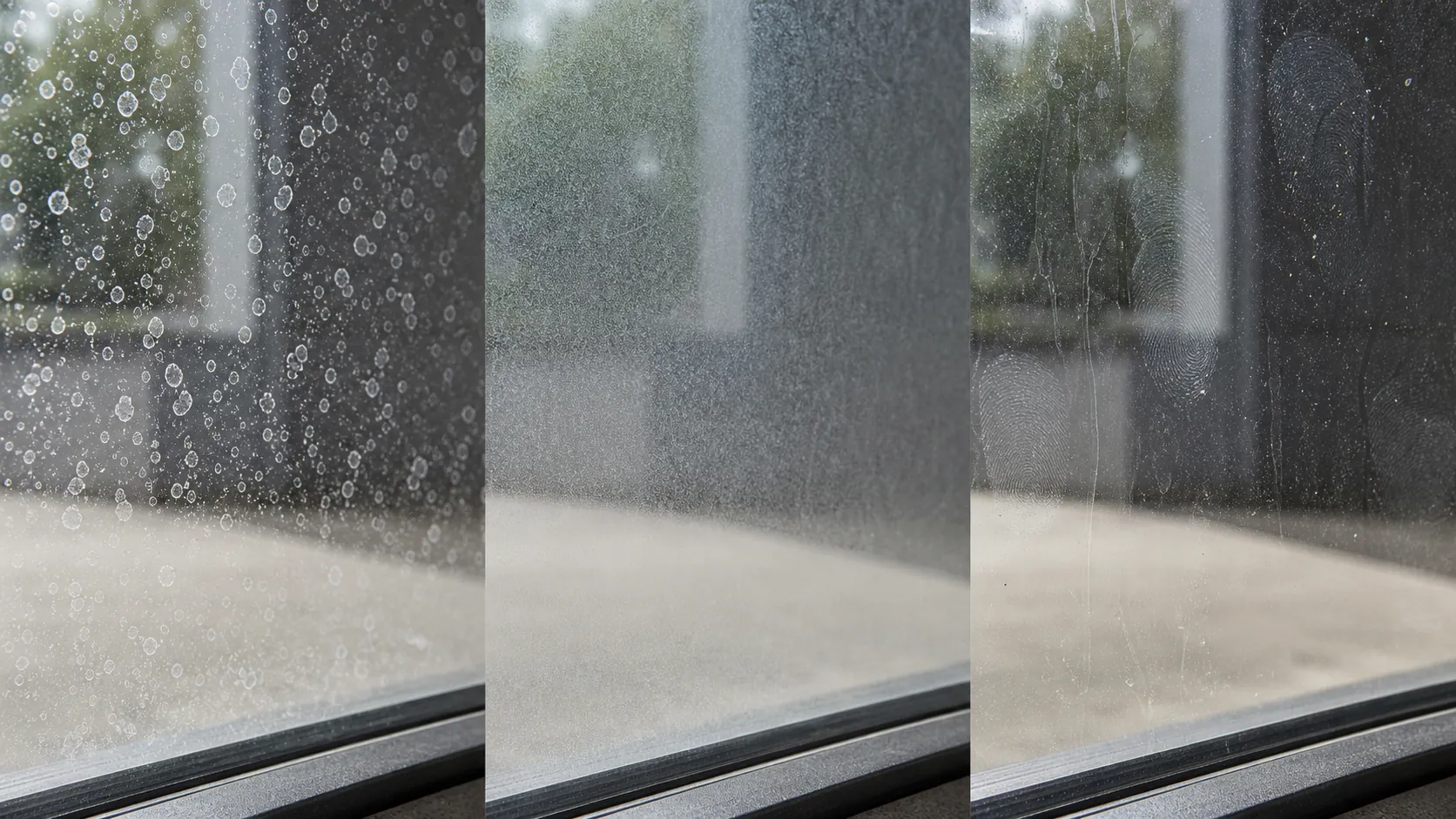
Four broad condition groups
| Condition | Typical clues | What routine cleaning can do |
|---|---|---|
| Surface soil or cleaning film | Changes when rewetted; may follow wiping or runoff patterns; often responds to a mild permitted cleaner | Can usually remove it when the cleaner is compatible with the surface |
| Mineral scale or bonded contamination | Droplet outlines, sprinkler arcs, vertical runs, crust, or a rough feel; may resist routine washing | May require a compatible deposit-removal process and controlled dwell |
| Altered glass, film, or coating | Haze remains after deposits are removed; reflection, color, gloss, or texture may differ | Cannot reverse missing coating or etched glass through washing alone |
| Internal insulating-glass condition | Fog, droplets, or deposits appear between sealed panes and cannot be touched from either exposed face | Cannot reach the condition; the glazing unit needs separate assessment |
What hard water leaves behind
The U.S. Geological Survey describes water hardness mainly in terms of dissolved calcium and magnesium. When a droplet evaporates from glass, the water leaves while dissolved material remains. Repeated wetting can build overlapping spots, runs, and crust, especially where sprinklers, facade leaks, cooling equipment, or irrigation keep supplying mineral-bearing water.
The deposit can also collect other material. Dust, metal runoff, masonry residue, detergent, and atmospheric soil may become part of the same layer. That is why two white deposits can react differently even on adjacent elevations.
Time matters. A recent surface deposit may release with an appropriate cleaner. Long exposure can produce a bonded scale or contribute to chemical alteration of the exposed glass. Removing what sits on top may reveal haze that is now part of the surface.
Map the pattern before testing chemistry
Look at the whole opening and the nearby building. A fan of spots at sprinkler height points to a different source than uniform fog between two panes. Vertical trails below a concrete joint, metal cap, or facade anchor deserve separate attention. A sharp boundary at the edge of an old film or sign can indicate adhesive, weathering, or different exposure.
- Inspect the pane dry in reflected and transmitted light.
- View it from indoors and outdoors when both sides are safely accessible.
- Check whether the condition crosses muntins, gaskets, film edges, or the spacer line inside an insulating unit.
- Note whether the surface feels smooth, rough, sticky, or unchanged. Do not use touch as the only identification method.
- Photograph the original condition with a fixed viewpoint and a close detail.
Also inspect for chips, cracks, edge damage, loose glazing, failed sealant, exposed coatings, and aftermarket film. A deposit-removal product that is acceptable for bare glass may harm a frame finish, sealant, stone sill, metal, tint, or coated surface.
Use a least-aggressive test sequence
- Select a representative area. Choose a section that contains the visible condition but does not hide a failure at the glass edge. Agree on the location when the result will be used to price a larger restoration.
- Clean routine soil first. Use clean water and a mild, non-abrasive solution permitted for the known glass construction. This prevents loose dirt from distorting the test.
- Rinse and dry completely. Judge the area only after water and cleaner film are gone. Wet glass can temporarily hide haze and scratches.
- Apply a compatible deposit test. If bonded mineral contamination remains, use a product and method approved for the exposed glass and adjacent materials. Control concentration, time, temperature, agitation, and runoff. Do not improvise an acid mixture.
- Neutralize or rinse as directed. Remove the test material fully, dry the pane, and compare it with the untouched area under the same lighting.
- Record the result. Note what released, what remained, whether gloss or reflection changed, and whether the tested process affected a frame, seal, coating, or film.
Stop the test if the surface changes unexpectedly, the product reaches an unknown coating, the glass or edge system appears unstable, or the process creates new haze. Escalation should follow evidence, not frustration.
How to read the test result
The area becomes clear
The visible condition was likely on the exposed surface and the tested method may be suitable for similar areas. It is not yet proof that the entire elevation has identical glass, deposits, exposure, or prior damage. Expand in controlled sections and keep checking.
The crust releases but a dull pattern remains
The deposit may have hidden an altered surface. Compare texture, gloss, reflection, and visibility from normal viewing distance. Further chemical cleaning is unlikely to rebuild glass that has been etched. A polishing test may be appropriate on compatible glass, but it is a restoration process that removes material and carries optical and thermal risks.
The test does not change the mark
Reconsider the diagnosis. The condition may be a scratch, coating defect, film damage, internal fog, silicone haze, or another residue outside the tested cleaner's purpose. Repeating a stronger version without identification can damage the pane while leaving the original condition in place.
The haze is between panes
If the condition cannot be reached from either exposed surface and lies inside a sealed insulating glass unit, exterior cleaning and surface polishing cannot touch it. Seal failure, desiccant saturation, internal deposits, or another unit condition requires evaluation of the glazing assembly, often with replacement of the insulating glass unit as the practical correction.
Why universal acid recipes are a poor diagnostic tool
Acid can react with mineral deposits, but it can also attack glass constituents, metals, masonry, coatings, films, sealants, skin, and surrounding property. Product strength is only one variable. Surface temperature, dwell time, previous chemicals, rinse control, and the construction of the window all change the outcome.
A recipe copied from another project does not establish compatibility. Use a labeled product within its instructions, review the safety data, protect adjacent materials, and plan containment and rinse water. When the glass or contamination is unknown, obtain technical guidance before applying reactive chemistry.
Cleaning, restoration, and replacement are different outcomes
Cleaning removes material from the surface without intentionally changing the glass. Restoration may use controlled abrasion or polishing to change a damaged surface. Replacement removes the glazing component when its construction or condition cannot be corrected safely in place.
Deep scratches, cracks, chips near an edge, missing reflective coating, failed film, internal fog, and unstable glazing do not become cleaning jobs because they are visible. A documented glass-restoration assessment should state both what can improve and what will remain.
Prevent the deposit from returning
Correct the water source before investing in a large restoration. Redirect sprinkler heads, repair facade leaks, examine condensate discharge, and keep mineral-bearing runoff away from glass. Where exposure cannot be eliminated, shorter maintenance intervals can remove fresh residue before it becomes a thick bonded layer.
Keep records of the glass type, approved maintenance product, treated elevations, and test results. The next cleaning crew should not have to rediscover a coating or repeat an incompatible chemical trial.