Downstream injectors, external injectors, and pump sprayers
Compare chemical paths, draw limits, reach, overspray, compatibility, calibration, field concentration, low-pressure activation, dedicated sprayers, flushing, and fault checks.
Choose the chemical path before the spray pattern
Three application tools can place a similar-looking fan on a wall while sending concentrate through very different components. A downstream injector draws after the pressure pump. An external injector draws at a specialized nozzle near the gun. A pump sprayer carries and pressurizes its own mixed solution.
The right choice depends on the product label, substrate, desired field concentration, required reach, wind, runoff control, equipment compatibility, production volume, and how the system will be rinsed.
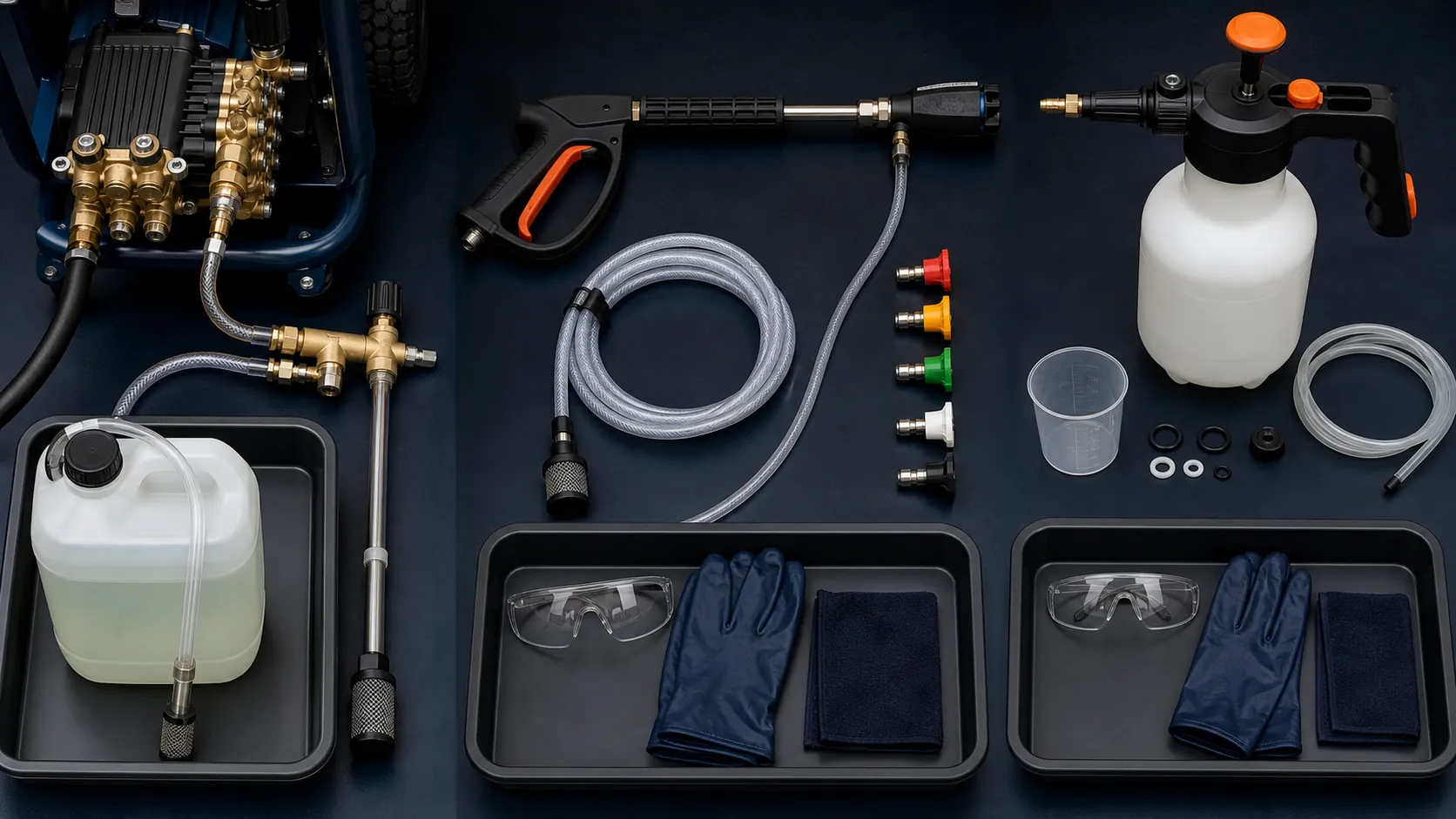
Downstream injection draws after the pump
A downstream venturi is installed in the discharge path after the high-pressure pump, with its arrow pointing toward the hose and gun. A pickup tube and screened strainer reach the chemical container. When the operator switches to an approved low-pressure outlet, the reduced downstream restriction lets the venturi draw concentrate into the water stream.
Returning to a working high-pressure nozzle normally stops draw. Because concentrate enters after the pump, fewer upstream components contact it. The injector, high-pressure hose, reel swivel, gun, lance, and downstream fittings still do. Their materials must be compatible.
Draw is affected by injector model and orifice, machine flow, outlet pressure, nozzle, discharge-hose length and diameter, elevation, chemical viscosity, pickup restriction, check-valve condition, and air leaks. A catalog draw ratio is not proof of the concentration at a specific job setup.
An external injector moves the venturi to the gun
An X-Jet-style external injector places the injection body at the outlet end. Its pickup hose runs from the nozzle assembly to the concentrate container. The manufacturer describes this arrangement as keeping chemical out of the pump, pressure hose, gun, and fittings upstream of the nozzle.
External injection can draw stronger solution than many downstream configurations and can provide useful reach when matched to machine flow and the correct internal orifice. It also means carrying or managing a chemical pickup hose near the operator. Higher concentration and long reach increase the consequence of wind and overspray.
Color-coded proportioning inserts restrict pickup flow. Use the chart for the exact injector, machine range, stock viscosity, and setup. Color by itself does not prove an on-surface percentage. The insert goes where the manufacturer specifies, and the installed injector orifice must match the pressure washer.
A pump sprayer separates application from the washer
A hand, backpack, or battery sprayer stores mixed product in its own tank and applies it through low-pressure hose, wand, and nozzle. It can provide precise local application, keep chemistry out of the pressure-washer path, and work without the pressure washer running. Reach and production rate are lower, and the operator carries the solution.
The sprayer must be designed for the exact chemical family. Tank, pump, seals, hose, shutoff, wand, nozzle, relief valve, and filter all matter. A unit labeled for acid is not automatically suitable for bleach, caustic material, solvent, flammable product, or a heat-generating mixture. Read both sprayer and chemical instructions.
Compare the operating tradeoffs
| Decision | Downstream injector | External injector | Pump sprayer |
|---|---|---|---|
| Chemical enters | After pump, before hose | At outlet nozzle | Separate tank and low-pressure circuit |
| Typical strength potential | Limited by venturi and complete hose setup | Often higher draw potential, model dependent | Mixed directly to labeled application concentration |
| Reach | Depends on machine and approved soap nozzle | Designed for reach with matched orifice | Generally local, nozzle and sprayer dependent |
| Overspray exposure | Present, especially at elevation | Can be substantial with strong long-range stream | More local control, still wind sensitive |
| Components to flush | Injector through nozzle | Pickup and nozzle assembly | Tank, pump, hose, wand, nozzle |
| Best fit | Repeat broad application at modest field strength | Reach or stronger draw within product and site limits | Small areas, detail work, or isolated compatible chemistry |
These are selection tendencies, not permission to exceed a label. The required application rate and concentration must be achievable without creating uncontrolled drift or runoff.
Calibrate with the exact field setup
Calibration should use the same machine speed, supply, injector, orifice, pickup tube, filter, chemical viscosity, hose, gun, outlet, elevation, and container position planned for work. Water-only calibration can protect the site and still reveal the hydraulic draw. If viscosity differs significantly from the product, follow the injector and chemical guidance for a representative safe calibration liquid.
- Fill a graduated pickup container with a known safe test volume.
- Run the application outlet for a measured interval into a suitable collection or controlled discharge.
- Measure pickup volume and total mixed output over that interval.
- Calculate the pickup fraction as pickup volume divided by total mixed output.
- Multiply the stock active concentration by that fraction to estimate field active concentration, subject to label definitions and mixture behavior.
- Repeat until readings are stable, then record the complete setup.
Be precise about ratio language. One part concentrate drawn with four parts carrier produces five total parts, not four. Some charts express water-to-chemical ratio, others chemical-to-total output. Convert to a field percentage before deciding whether the label target is met.
A pump sprayer is simpler only when the mix is measured correctly. Account for concentrate strength and final total volume, not just water added. Use dedicated measuring equipment and never return mixed product to the original concentrate container unless the label explicitly permits it.
Apply according to the surface and label
Protect people, plants, glass, metals, painted surfaces, electrical equipment, vehicles, and air intakes as required. Establish wind and drift limits. Work in manageable sections so product stays within its labeled dwell and does not dry when prohibited. Apply from a stable position and never aim a long-range chemical stream where the landing zone is hidden.
Plan collection or lawful discharge before application. Pre-wetting and post-rinsing depend on the product and adjacent material. More chemical is not a substitute for agitation, dwell control, temperature selection, or a compatible cleaning process.
When a downstream injector will not draw
- Confirm the injector arrow points downstream.
- Use the correct low-pressure control nozzle or lance position.
- Check that injector size matches system flow, pressure, and temperature.
- Inspect the pickup screen, tube, metering device, barb, and check valve.
- Eliminate air leaks and excessive pickup lift.
- Consider discharge-hose length, downstream restriction, and product viscosity.
Do not drill the injector orifice or remove safety parts to increase draw. A clogged or incorrectly sized injector can increase load on the pump and engine.
Flush and depressurize by component instructions
After application, remove the pickup from concentrate and draw the approved rinse liquid through the complete chemical path for the specified time. Rinse external-injector hoses and nozzle parts. For a pump sprayer, release tank pressure through its designed relief method before opening, then empty, rinse, pressurize briefly, and spray the rinse through hose, wand, and tip as directed.
Do not store mixed chemical in a sprayer unless both product and sprayer explicitly allow it. Dedicated sprayers reduce cross-contamination risk, but they still require labeling, inspection, compatible replacement seals, and safe storage.
A professional power-washing process treats calibration as a measured field condition. The injector is a delivery device, not a concentration guarantee.