Cleaning concrete without etching, stripes, or exposed aggregate
Identify the slab and contamination, establish the least aggressive dry-approved test, coordinate chemistry and hydraulic force, overlap consistently, control runoff, and stop before weak paste is removed.
The clean stripe may be damaged concrete
A pressure-washer pass can look impressively bright while the slab is wet. After drying, the same path may reveal wand marks, a roughened cement paste, exposed aggregate, a lighter etched band, or a dark strip that the next pass missed. Cleaning removes contamination. Surface preparation intentionally changes the concrete profile. Mixing those objectives creates expensive surprises.
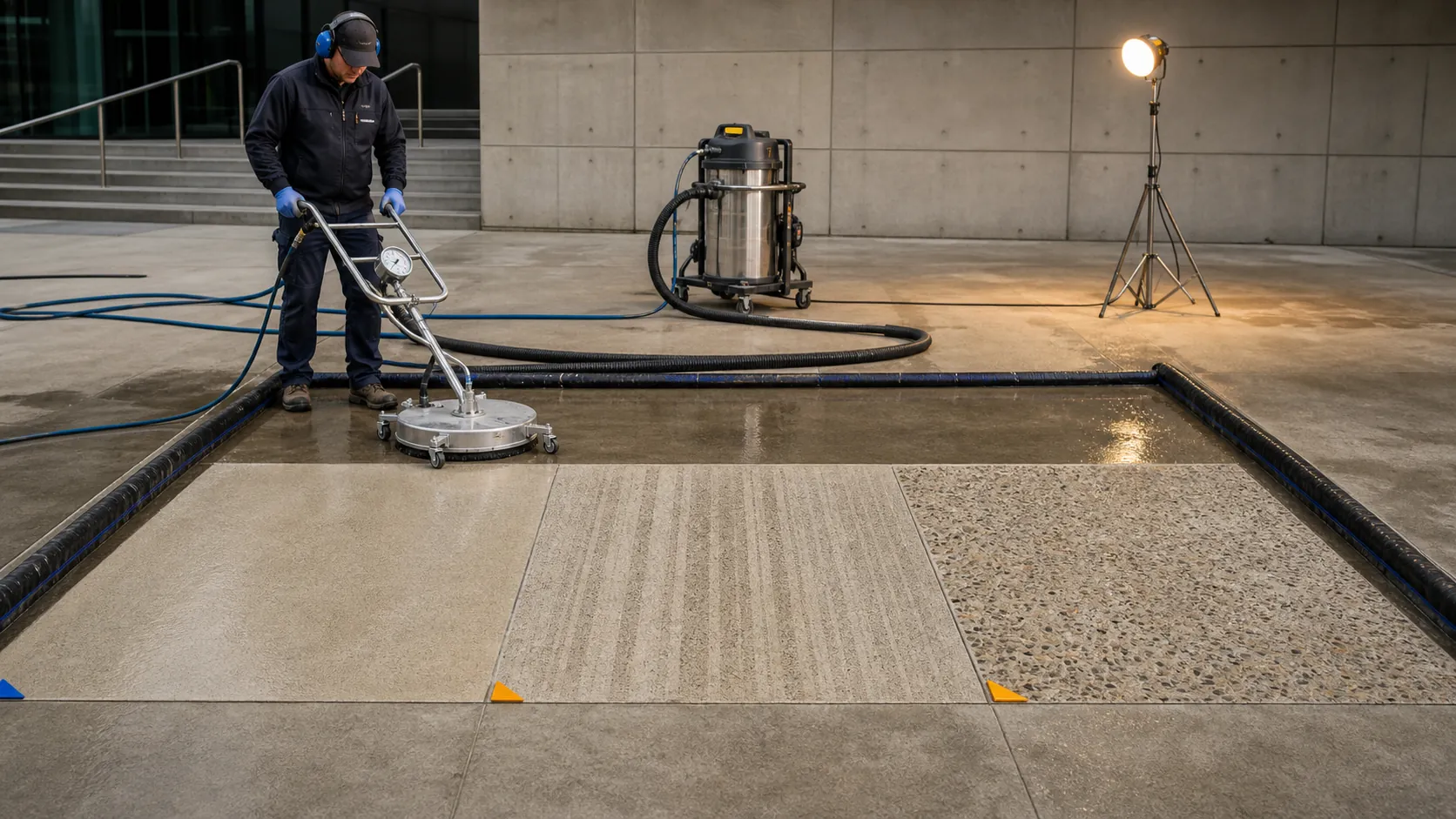
There is no single safe PSI for all concrete. Strength, age, mix, curing, finish, wear, repairs, sealer, moisture, and prior chemical exposure all matter. The machine's pressure is only one part of the force that reaches the surface.
Identify the concrete before the stain
Walk the complete area in dry conditions. Record construction joints, control joints, cracks, spalls, delamination, scaling, soft paste, prior patches, exposed reinforcement, settlement, and ponding. Determine whether the finish is broomed, troweled, stamped, polished, integrally colored, stained, exposed aggregate, precast, or coated.
Find the approximate age and repair history. New concrete may have curing restrictions. Old concrete may have weak surface paste or freeze-thaw damage. A sealed decorative driveway and an uncoated loading dock should not receive the same trial.
Test for a coating or sealer according to the responsible manufacturer or consultant. Water beading alone is a clue, not a full identification. An unknown acrylic, penetrating treatment, curing compound, paint, or densifier changes chemical compatibility and the expected appearance.
Classify the contamination
| Condition | Pressure alone is likely to | Plan instead |
|---|---|---|
| Loose soil and light traffic film | Move it if flow, agitation, and collection are adequate | Start with sweeping, suitable cleaner if needed, and broad controlled rinsing |
| Oil or grease | Spread surface oil and leave penetrated staining | Contain fresh material and use a compatible degreaser or extraction method |
| Rust | Remove loose oxide but leave chemical staining | Identify source and test substrate-specific rust treatment |
| Organic growth | Strip visible material without necessarily treating regrowth | Identify the organism and use a labeled compatible product where appropriate |
| Efflorescence or cement residue | Move loose crystals but not correct salt movement or bonded residue | Review moisture source and use concrete-specific chemistry only after testing |
| Rubber or tire marks | Reduce loose transfer but may drive uneven close-range work | Use compatible product and agitation before a uniform rinse |
A stain-specific treatment can be less damaging than trying to erase it with a narrow jet. Protect adjacent glass, metal, paint, plants, sealants, and masonry from both chemistry and runoff.
Understand the variables at the nozzle
Operating pressure, flow, nozzle orifice, fan angle, distance, angle of attack, travel speed, dwell at turns, and number of passes combine at the concrete. A small nozzle close to the slab can remove paste even when the gauge reading sounds moderate. A high-flow wide fan farther away can rinse more effectively with less concentrated impact.
Use the machine and accessory manufacturer's sizing chart. Verify the nozzle is not worn or partially blocked. Do not use the unloader to improvise a pressure setting outside the equipment procedure. A turbo or zero-degree nozzle concentrates force and is a poor starting tool for appearance-sensitive concrete.
Build a test panel that includes the difficult edge
Select an inconspicuous but representative area with typical soil, a joint or edge, and any color or finish variation. Protect runoff routes and establish a clean control. Begin with the least aggressive combination that can reasonably work.
- Remove loose dry debris.
- Pre-wet adjacent materials and concrete if the selected product requires it.
- Apply compatible chemistry at the labeled concentration and rate.
- Keep the area within its stated dwell condition without letting product dry.
- Agitate only with an approved tool.
- Rinse from a consistent distance, angle, speed, and direction.
- Collect and dispose of wash water under the site plan and local requirements.
- Let the test dry to a stable color before acceptance.
Record equipment, nozzle, measured operating condition, chemistry, dilution, dwell, temperature, pass pattern, and result. A wet phone photo is not an acceptance standard.
Use a surface cleaner as a controlled tool
A rotary surface cleaner can improve distance and path consistency on suitable horizontal concrete. It does not make an aggressive setup safe. Match deck diameter, nozzle pair, orifice, pressure and flow rating, swivel limits, and machine output. Inspect nozzles for equal size and alignment.
Start and stop in the designated area by the manufacturer's procedure. Keep the deck moving at a repeatable pace. Overlap adjacent paths enough to avoid untouched bands, but do not pause at edges or repeatedly polish one lane. Change direction or make a light cross-pass only if the approved test demonstrates that method.
Striping can come from unequal or worn nozzles, incorrect height, clogged tips, bent spray bar, failing swivel, inconsistent walking speed, inadequate overlap, or contamination that chemistry did not loosen evenly. Correct the cause instead of slowing down over each dark stripe.
Edges and vertical surfaces need another plan
A hand lance is often used where a surface cleaner cannot reach. Match its fan and working distance to the dry-approved test. Feather the edge into the main field rather than tracing a bright outline around walls and joints. Keep the stream out of cracks, expansion joints, door thresholds, facade joints, electrical components, and slab edges that lead to occupied space.
Formed architectural concrete can show wand marks and color variation readily. ACI guidance for appearance-sensitive formed surfaces emphasizes test methods and restrained pressure rather than using high pressure as stain removal. Follow project specifications and the concrete producer or coating manufacturer.
Chemistry can etch even when the nozzle does not
Acidic concrete cleaners may dissolve cement paste and expose aggregate. Some are specifically marketed to etch or increase exposure at stronger concentrations. That can be appropriate for a specified preparation project and wrong for maintenance cleaning. Alkaline degreasers and solvents bring different coating, worker, and runoff risks.
Never mix products. Follow label and safety data sheet for personal protection, ventilation, application, neutralization if specified, rinse, and disposal. Do not allow chemistry to dry or collect in low spots. Keep a wet edge according to the product procedure and work in sections that can be fully rinsed.
Inspect dry before expanding
Compare test and control from standing height and normal approach directions. Check color, gloss, texture, aggregate exposure, joint edges, coating integrity, slip condition, and any raised fibers or paste. View in sun and shade if both occur on the site.
If the test is cleaner but rougher, it did not pass a maintenance-cleaning objective. If a dark stain remains but the surface has begun to lighten or erode, stop. The remaining condition needs a stain-specific treatment, acceptance as residual, repair, or replacement, not more hydraulic force.
A professional power-washing scope should preserve the concrete that is already there. Uniform drying, not the brightest wet stripe, is the useful measure of success.