Choosing an access method for exterior glass
Compare ground work, water-fed poles, ladders, lifts, scaffolds, and rope descent by reach, exposure, anchors, rescue, surroundings, glass detail, and finish quality.
Access is the first tool selected
A pane may be washable with a strip washer, pure water, or another approved process. That does not explain how a technician can reach it, control the tool, protect everyone below, and leave if conditions change. Choose access before choosing the cleaning motion.
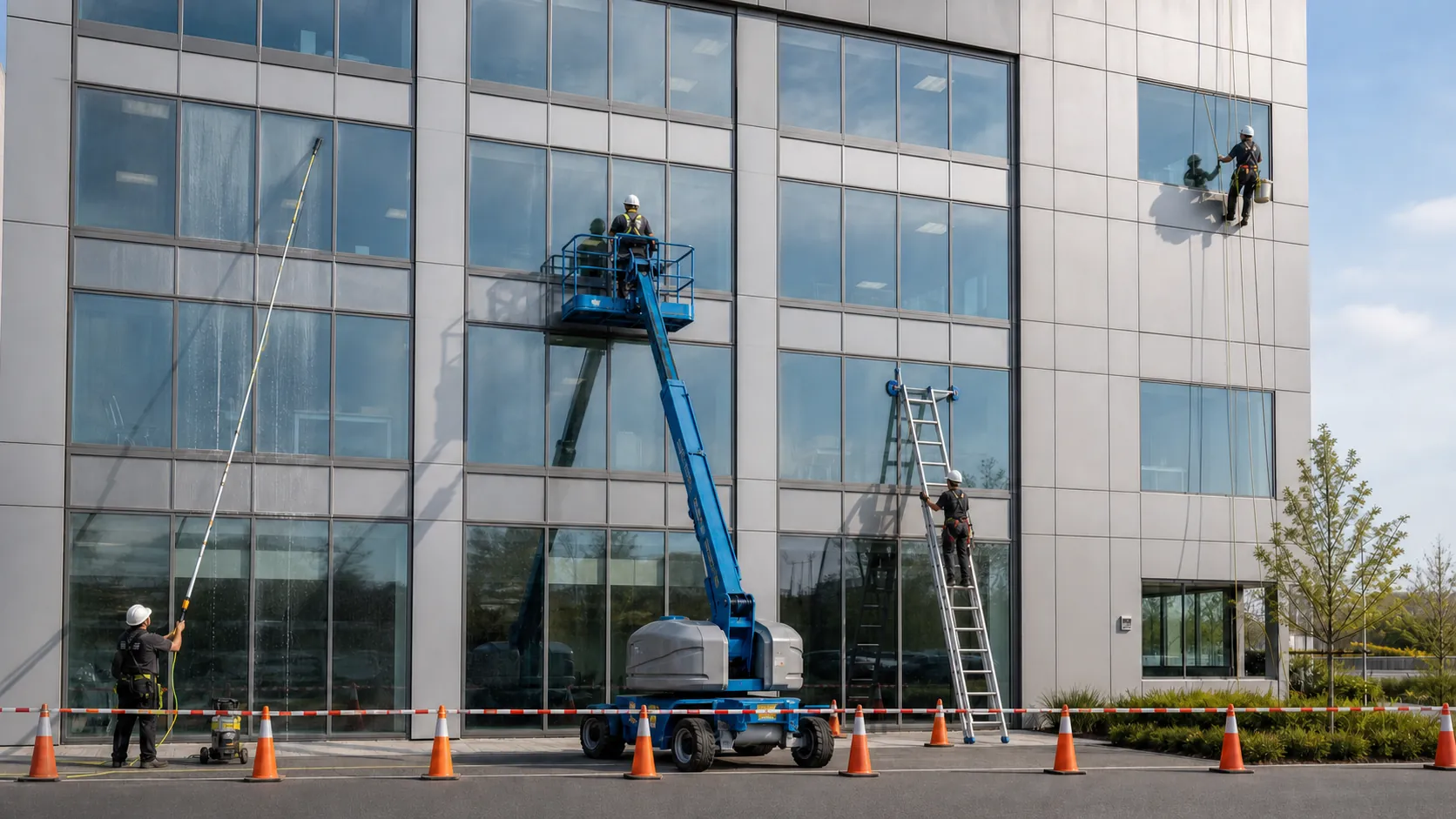
This guide is a planning framework. It does not replace training, equipment instructions, an employer safety program, or the fall-protection and scaffold rules that apply to the site.
Survey the route, not only the glass
Start at the approach. Record gates, steps, slopes, soft landscaping, loading limits, overhead conductors, roof access, parapets, traffic, entrances, and areas where people can appear without warning. Then map every lite by elevation, height, setback, projection, opening type, frame depth, contamination, and required finish.
A drawing helps, but a field walk catches the awkward parts: a canopy beneath the target pane, a lift route that narrows behind a planter, a pole that would cross a service line, or a roof door that cannot accommodate rescue equipment. Day and night use may differ. A quiet sidewalk during the estimate can become a school or restaurant queue during work.
Use a method hierarchy
Begin with a method that keeps the worker on a stable surface and removes fall exposure, provided it can still control the work. Move to another system when reach, quality, obstacles, glass condition, or surroundings make the lower-exposure method unsuitable.
| Method | Fits when | What can disqualify it |
|---|---|---|
| Ground tools or water-fed pole | The pane is within controlled reach and the worker can agitate, rinse, inspect, and manage the hose from a stable zone | Electrical exposure, excessive flex, blind ledges, heavy bonded soil, open windows, poor rinse control, or falling debris |
| Portable ladder | Short-duration work has a suitable level setup, secure support, correct ladder, controlled access, and compliant work practice | Unstable ground, doorways, traffic, overreach, long lateral scope, fragile contact surface, weather, or a task that needs two free hands |
| Mobile elevating work platform | The machine can reach the work and travel on a verified surface while the operator maintains basket control | Insufficient bearing capacity, slope, overhead hazards, narrow access, wind, public interface, or incompatible outreach |
| Supported scaffold | A larger work face benefits from a stable platform designed, erected, inspected, and accessed for the load and task | Poor foundations, incomplete edge protection, unapproved alterations, traffic conflict, or inadequate access |
| Suspended scaffold or rope descent | The building and employer program support the exact system, trained workers, independent fall protection, verified anchors, rigging, rescue, and drop-zone control | Unknown anchors, unsuitable roof geometry, missing certification, unsafe wind, unprotected edges, incompatible facade details, or no workable rescue plan |
A water-fed pole still needs a work zone
Staying on the ground removes one exposure and introduces others. Long poles can become difficult to control, especially in wind. Hoses cross walking routes, wet hardscape becomes slippery, brush stock can fall, and a conductive path near electrical equipment can be fatal. Establish electrical clearances under the applicable rules. Do not treat a fiberglass or carbon-fiber pole as permission to work near power.
Confirm that the brush can reach the frame and corners without levering against glass. Watch for vents, loose caps, open sashes, deteriorated seals, and deep ledges that retain dirty water. If the worker cannot see and rinse the upper frame, a clean pane may receive runoff after the pole moves away.
A ladder is a position, not a roaming platform
Verify the ladder type, duty rating, length, feet, rails, locks, setup surface, support point, access control, and inspection status. Keep the worker centered between the rails. Reposition instead of leaning across the pane. A standoff can protect a frame and improve position only when it is approved for the ladder and bearing surface.
If a task requires prolonged side loading, forceful scraping, large buckets, repeated transfers, or both hands away from stable contact, reconsider the method. The fact that a pane can be touched from a ladder does not make the whole cleaning process suitable from that position.
Lifts and scaffolds move the planning upstream
For a lift, confirm model-specific training, inspection, rated load, reach envelope, wind limit, slope, ground pressure, overhead clearance, fall-protection requirements, and emergency lowering. Plan delivery and travel before the machine arrives. Outriggers and wheels cannot be placed on a decorative cover, vault, uncompacted edge, or unknown slab simply because the surface looks flat.
Scaffold planning includes foundation, ties or suspension, platform, guardrails, access, falling-object protection, inspection, alterations, and the combined weight of people, water, tools, and materials. Workers should not improvise a missing component or move a system outside its design.
Rope access starts with verified structure
A roof pipe, railing, mechanical curb, or convenient steel member is not automatically an anchor. The building owner and qualified parties must identify, verify, document, and maintain anchorage as required for the system. Rope descent also needs independent fall arrest, edge protection, rigging control, descent limits, communication, public exclusion, and a rescue plan that works at that elevation.
Inspect the descent path for projecting glass, fins, signs, open windows, hot exhaust, sharp edges, and facade components that can damage a line. Coordinate occupants so a sash or door cannot open into the technician.
Define change triggers before the shift
- Wind, lightning, heat, rain, or visibility exceeds the method limit
- The ground, roof, anchor, ladder support, or travel route differs from the survey
- People enter the drop zone or traffic control fails
- An electrical exposure or unknown building service appears
- The pane, frame, coating, seal, or contamination requires more force or a different tool than planned
- The worker cannot maintain communication, inspection, or the planned rescue route
Stop, secure the area, and revise the plan. Changing from a pole to a ladder or from a lift to rope descent is a new access decision, not a small field adjustment.
Record the selection
The job file should connect each elevation to its method, equipment, trained crew, inspection, exclusion zone, weather limit, and emergency arrangement. It should also note panes left out because the available method could not meet both safety and finish requirements.
A professional window-cleaning plan does not force one access system onto an entire building. It gives every pane a controlled route in, a controlled working position, and a controlled route out.